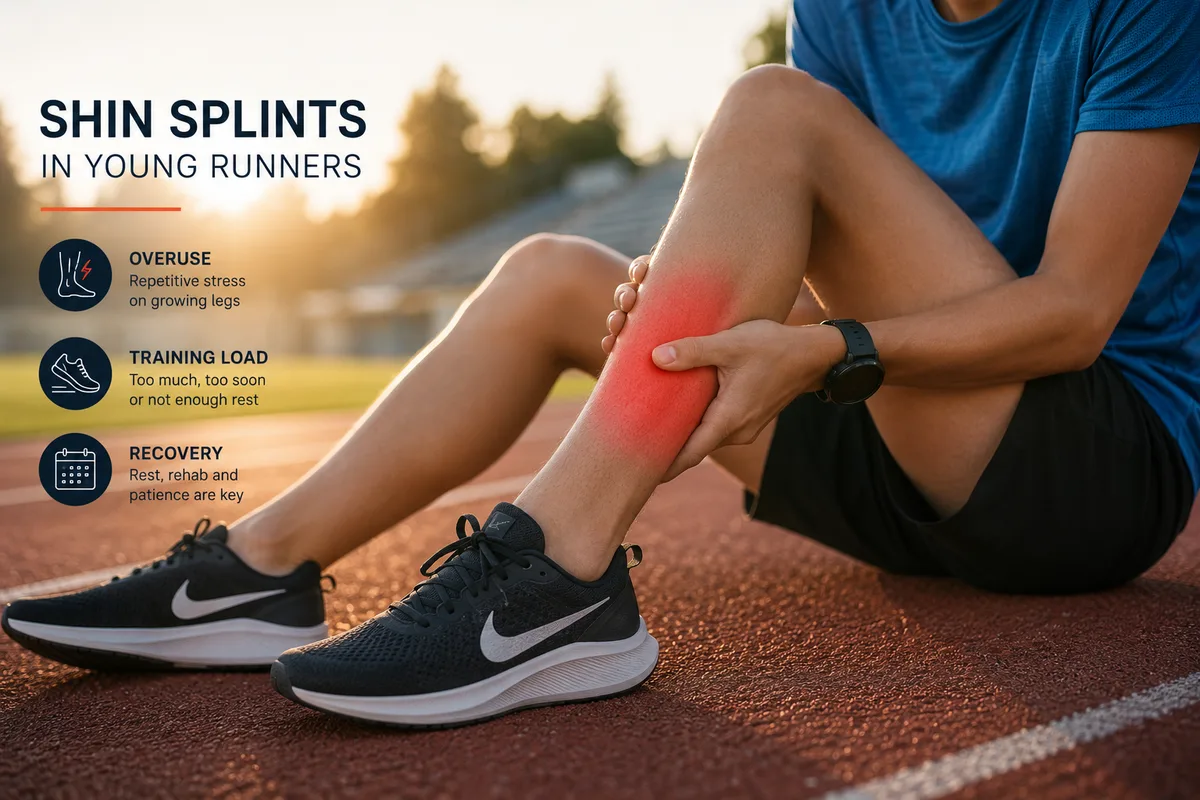
"Shin splints" is one of the most common things a young runner will complain about, and one of the most commonly shrugged off. Most of the time it is exactly what it sounds like — an overuse ache that settles with sensible rest. But it is also the label that gets stuck on shin pain that turns out to be something more serious, and in a still-growing child that distinction is the part worth getting right.
This is what shin splints actually are, what helps, and — the bit that matters most — how to tell when shin pain needs a professional rather than a week off.
What shin splints actually are
The clinical name is medial tibial stress syndrome, or MTSS. It describes pain along the inner border of the tibia — the shin bone — brought on by running, jumping, and other repetitive impact. It is an overload injury: the bone and the muscles and connective tissue that attach along it are being stressed faster than they can adapt and recover. Rather than one single problem, it sits on a spectrum of bone stress and soft-tissue overload running down the shin.
It is extremely common. Depending on the group studied, MTSS affects somewhere between 5% and 35% of runners, accounts for roughly 9% of all running injuries, and turns up most often in newer runners and those who have recently ramped up their training. Girls are affected more than boys — by some estimates a little over twice as often. It is well documented in adolescent and teenage runners specifically, which is the group most likely to be training at the volume that brings it on.
Why it happens
The thread running through almost every case is the same: the shin is being asked to absorb more than it has had time to adapt to. The biggest single cause is a training error — a sudden jump in how far, how often, or how hard a child is running or jumping. Hard or uneven surfaces add to it. So do worn-out or unsuitable shoes, a foot that rolls inward markedly when it lands (overpronation — the same mechanics we cover in our flat-feet article), tight or weak calves, weak hips, a higher body weight, and a previous history of the same thing. In a child going through a growth spurt, fast-growing bones and tight muscles can stack onto all of that.
None of these is exotic. Most are controllable, which is the encouraging part.
What it feels like
The hallmark is a dull ache or tenderness spread along several centimetres of the inner shin — not a single sharp point. Early on, it tends to be sore at the start of a run, ease off as the child warms up, then return afterwards and the next morning. Left unmanaged, it arrives sooner in each session, lasts longer, and can eventually be there during ordinary walking around.
When it is not just shin splints
This is the section to read twice. Shin pain in a young athlete can also be a tibial stress fracture — a more serious bone injury that lives at the far end of the same stress spectrum, and one that needs proper rest and assessment. Training through it risks turning a hairline injury into a complete fracture.
The warning signs that point away from ordinary shin splints and towards something that needs looking at:
- Pain at one pinpoint spot you could cover with a fingertip, rather than spread along the shin.
- Pain that is there at rest, or at night, or wakes the child up.
- Sharp, localised shin pain when the child hops on that one leg.
- Swelling over the shin.
- Pain that keeps getting worse, or doesn't meaningfully settle after a couple of weeks of backing off.
If any of those are present, or the pain simply isn't improving, get it seen. In a growing child it is never the wrong call to have persistent shin pain assessed rather than assumed.
What helps
For ordinary shin splints, the management is conservative and effective.
Relative rest. The aggravating activity — running, jumping — comes down or stops for a while, while fitness is kept up with something low-impact like swimming or cycling. Symptoms commonly settle over two to six weeks, though it varies, and rushing the return is the usual reason it drags on.
Strength, not just rest. The evidence supports building the calf (eccentric calf raises are the staple) along with hip and core stability. A foot and lower leg that are stronger tolerate load better and the problem is less likely to come back. A physiotherapist can set an age-appropriate programme.
A gradual return. When the pain has settled, the child restarts at well under half their previous running volume and builds slowly, guided by whether the shin stays comfortable. Early on, it helps to avoid hills, uneven ground and very firm surfaces, and a slightly quicker, shorter stride reduces the load going through the shin. From then on, the simplest prevention rule is to increase weekly running by no more than about 10% at a time.
The footwear and surface connection
It is worth being honest here: training load is the biggest lever, not gear. But footwear and surface are two of the risk factors a parent can actually control. Worn-out cushioning passes more impact into the shin, so a pair that is past its life is worth replacing (we cover how to tell, and why the foam dies before the shoe looks worn, in our pieces on replacing running shoes and on shoe foam). A sudden switch to minimalist or barefoot shoes spikes the load on the shin, so any move that way should be slow and gradual — the subject of our article on how much cushioning a child needs. And consistently hard surfaces raise the risk, which matters more here than in most places.
A foot that rolls in significantly may do better in a more supportive shoe — but note the nuance from our flat-feet article: arch-support insoles are not recommended for a child with flat feet who has no symptoms. A symptomatic young runner with marked pronation is a different case, and one worth a podiatrist's eye rather than a guess at the shop counter.
The Dubai dimension
Two local realities make shin splints worth a parent's attention here. First, surfaces: most youth running and training happens on unforgiving ground — 3G turf, pavement, dry compacted pitches, indoor courts — and hard surfaces are an established risk factor. Second, the calendar: Dubai sport runs year-round, with no real off-season, so training load accumulates without the recovery a seasonal break would normally force. The classic trigger is ramping back up hard after a holiday or a spell of travel, or a sudden switch — for instance onto a treadmill, or into the busy October-to-March competitive months. The fix is the same either way: build the load up gently rather than in jumps.
The takeaway
Most shin splints in young runners settle with sensible load management, some calf and hip strengthening, and a patient, gradual build back to full training. Two things matter more than anything else: don't let a child push through pain that is getting worse, and don't assume all shin pain is shin splints. Pinpoint pain, night pain, or pain that won't settle deserves a professional look — because the one thing you don't want to miss is the injury that needs real rest to heal.
Sources
- Reshef N & Guelich DR. Medial Tibial Stress Syndrome — clinical review.
- Medial Tibial Stress Syndrome — StatPearls, NCBI.
- Hamstra-Wright KL, Bliven KCH & Bay C (2015). Risk factors for medial tibial stress syndrome in physically active individuals: a systematic review and meta-analysis. British Journal of Sports Medicine, 49(6):362–369.
- Newman P, Witchalls J, Waddington G & Adams R (2013). Risk factors associated with medial tibial stress syndrome in runners: a systematic review. Open Access Journal of Sports Medicine, 4:229–241.
- Yagi S, Muneta T & Sekiya I (2013). Incidence and risk factors for medial tibial stress syndrome and tibial stress fracture in high-school runners.