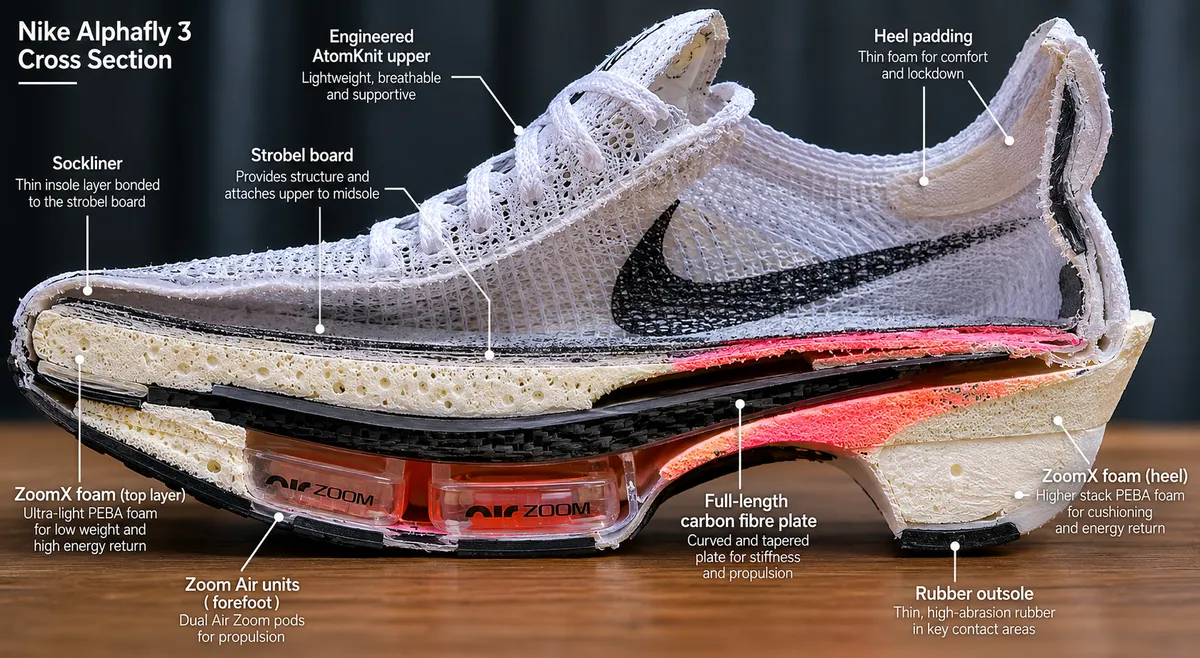
In 2016, Nike released a running shoe that would go on to reshape competitive distance running. Its name referenced a 4% improvement in running economy. The number was unusually specific for a shoe marketed to the public. It was also, it turned out, real.
The shoe's carbon fibre plate got most of the headlines. The actual revolution was the foam underneath it.
This is a guide to what running shoe midsoles are made of, what that means for your body, and why the gap between a budget trainer and a racing shoe is mostly — though not entirely — a chemistry problem. Yes, it is going to get nerdy. Apologies in advance.
The workhorse: EVA
For roughly four decades, virtually every running shoe midsole was made of the same material: ethylene vinyl acetate, or EVA. It is a copolymer foam — a blend of two polymers that together produce something lightweight, compressible, cheap to manufacture, and decent at absorbing impact.
Decent. Not exceptional. EVA returns approximately 60–65% of the energy you put into it. The rest is lost as heat — mechanical energy converted to warmth and dissipated into the air, unavailable to help you forward. Every stride, a small tax paid to physics.
EVA also has a well-documented durability problem: the foam cells compress under load and don't fully recover. After 300–500 km, they're permanently deformed. The shoe looks and feels much the same on the outside. The cushioning has quietly degraded by up to 40%. This is why the question "when should I replace my running shoes?" generates such disagreement. The answer depends on whether you're talking about the upper, the outsole, or the midsole — and the midsole often gives out long before anything visible shows it.
Modern manufacturers have improved on traditional EVA through supercritical foaming: injecting CO₂ or nitrogen into the polymer under high pressure, then releasing it rapidly to create a lighter, more responsive cell structure. Hoka's midsoles are predominantly EVA-based and use this technique. So does Mizuno. The foam is expanded, the density drops, and the ride changes. It is still EVA. It is better EVA.
The revolution: PEBA
PEBA — polyether block amide — is not a new material. It had been used in industrial applications for decades. What Nike worked out, with their proprietary ZoomX foam, was that when foamed correctly, PEBA produced a midsole that behaved unlike anything previously put in a running shoe.
The numbers tell the story. PEBA returns approximately 80–87% of input energy, compared to 60–65% for conventional EVA. That gap is significant. In an activity where you're taking 170–180 strides per minute over hours at a time, every fraction of a percent of recovered energy compounds.
The original Hoogkamer et al. study at the University of Colorado — the one that gave the Vaporfly its name — tested 18 trained runners at multiple speeds. All 18 ran with better economy in the PEBA-foamed shoe. The mean improvement was just over 4%. The lead researcher noted he had never seen a finding that robust. Individual results ranged from 1.6% to 6.3%. For context, shaving 4% off a four-hour marathon time is roughly ten minutes.
Nike calls their PEBA foam ZoomX. Adidas calls theirs LightStrike Pro. ASICS uses FF Blast Turbo in their elite racing line. Saucony uses PWRRUN PB. These are all proprietary variations on the same underlying chemistry. PEBA is the quiet revolution that made super shoes possible.
It is also lighter. PEBA foams run 20–30% lighter than comparable TPU formulations at the same stack height. Manufacturers could build thicker, more cushioned midsoles — improving energy storage — without the weight penalty that would slow the shoe down. The tall, pillowy appearance of modern racing shoes is largely a consequence of this.
PEBA does have one notable drawback: it degrades faster under hard use than EVA. Research has found a measurable increase in energy cost in well-worn PEBA shoes that isn't seen in equivalent EVA shoes. The £250 racing shoe is giving everything it has — and giving it out faster than the £80 trainer. Elite marathoners often retire race shoes after a single event for exactly this reason.
The middle ground: TPU
Thermoplastic polyurethane sits between EVA and PEBA on the energy return spectrum: approximately 70–75%, better than traditional EVA, short of PEBA's ceiling.
The most recognisable TPU application in running shoes is Adidas Boost: small beads of expanded TPU fused together into a midsole. The bead structure produces Boost's distinctive appearance and its responsive, springy underfoot feel. When it launched in 2013 it was genuinely ahead of its time. It has since been supplemented in Adidas's race-day shoes by LightStrike Pro (PEBA-based), but Boost remains widely used across training lines for good reason: it's durable, temperature-stable, and consistent over high mileage.
TPU also handles cold weather better than PEBA, which can stiffen in low temperatures. If you're running winters in northern Europe, that matters.
The lever: what the carbon plate actually does
Carbon fibre plates get most of the credit in super shoe conversations. They deserve some of it. But the mechanism is subtler than the marketing suggests, and the foam does more of the work than the plate.
A stiff plate running along the length of the midsole does two things. First, it limits the natural dorsiflexion of the metatarsophalangeal joint — the knuckle at the base of your toes — during toe-off. Normally that joint flexes significantly as the foot rolls through and the heel lifts. That flexion requires muscular work: the calf, the arch, the toe flexors all contribute. A rigid plate reduces that joint travel, reducing the muscular demand.
Second, the curved geometry of modern plates creates a rocker effect: the heel lifts more readily, the transition through midstance is guided, and the toe-off phase arrives earlier. The plate acts as a rigid lever arm, increasing the mechanical advantage at the ankle joint.
Foam and plate together: the foam stores and returns energy like a spring. The plate is the lever that channels that energy into forward motion. You're not running faster because the shoe is pushing you. You're running at the same perceived effort and covering ground more efficiently, because less of that effort is being wasted at the toe and ankle joints.
World Athletics, in limiting road racing shoes to a maximum 40mm stack height and one embedded plate, was implicitly acknowledging what the research showed: beyond those parameters, the equipment begins doing too much of the running. The line between athletic performance and engineering assistance gets uncomfortably blurry.
The honest caveat
All of the above assumes your specific gait, foot shape, and mechanics respond well to a given shoe. They may not.
High-stack PEBA foam is less stable than EVA. It can increase ankle instability in runners who pronate significantly. Carbon plates reduce toe flexion — excellent for efficient toe-off in one runner, a plausible contributor to metatarsal stress fractures in another. The 4% mean improvement in the Vaporfly study had an individual range of 1.6% to 6.3%. Some people genuinely run worse in super shoes.
The foam and the plate are tools. Very well-engineered tools, built on decades of materials research and serious biomechanics science. But they interact with your specific foot, your training history, and your injury profile in ways no single study can predict for you.
The best running shoe is still, somewhat frustratingly, the one your body runs best in.
Sources: Hoogkamer et al. 2018, University of Colorado Locomotion Lab — Running Economy of the Vaporfly 4% · Rodrigo-Carranza et al. 2024, Scandinavian Journal of Medicine & Science in Sports · Spark Foamtech — PEBA vs EVA analysis · World Athletics Technical Rules (footwear regulations)