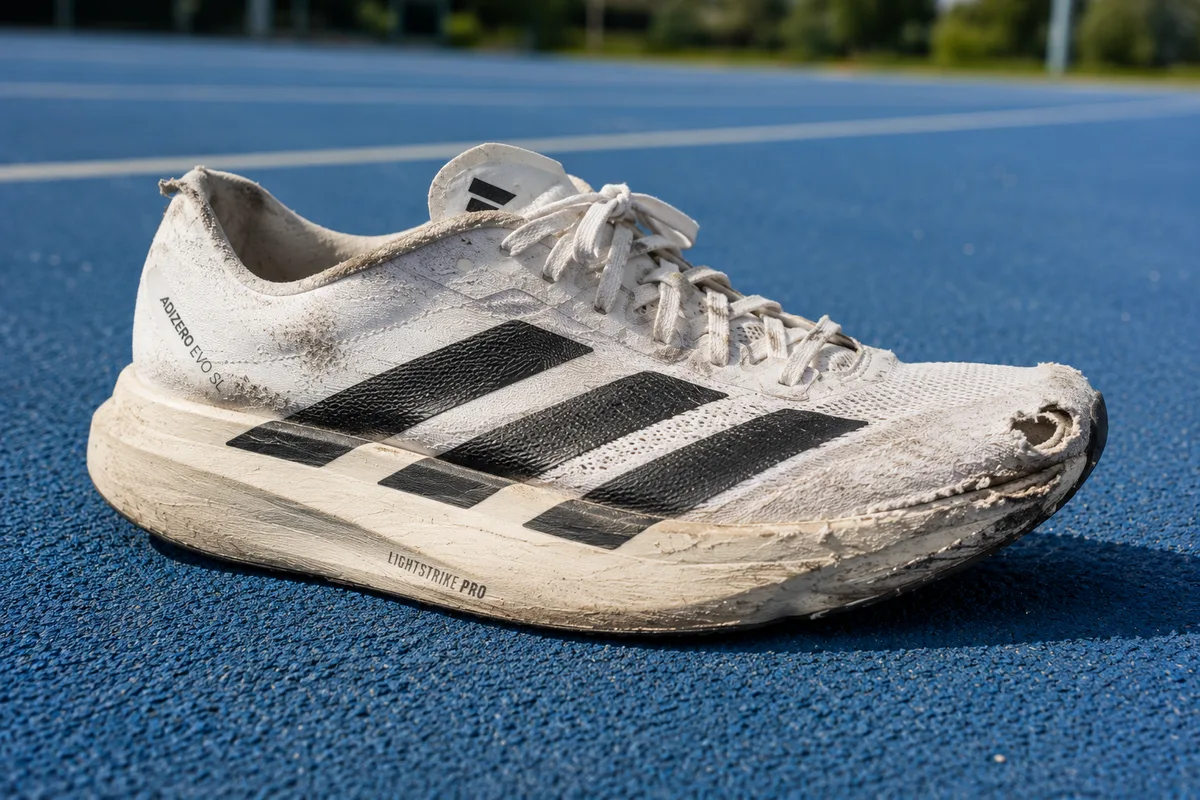
A running shoe can look perfectly fine and be finished. The part that wears out first is the foam under the foot, and it does most of its dying on the inside, where you cannot see it. By the time the outside looks tired, the shoe has usually been past its best for a while.
For a child's shoe there is a second question on top of that — whether the foot has simply grown out of it. Knowing which of the two is happening, and how to spot each, saves you both money and sore legs.
The cushioning goes before the shoe looks worn
The classic rule of thumb is to replace running shoes somewhere around 300 to 500 miles — roughly 480 to 800 kilometres. It is a rough guide, not a law, and for children it is rarely the useful number. What matters is what is happening to the foam.
The foundational research here is older than most parents, and still holds. A 1985 study in the American Journal of Sports Medicine mechanically ran shoes through the equivalent of up to 500 miles and measured how much shock they still absorbed. The shoes kept about 75% of their original cushioning after 50 miles, around 67% by 100 to 150 miles, and under 60% between 250 and 500 miles. Worn on real runners rather than a machine, the loss was gentler — about 70% retained at 500 miles — but the direction is the same and the lesson is blunt: a shoe can quietly shed a third of its cushioning while the upper still looks brand new. Most of that loss happens earlier than people assume.
The mechanism is simple. The midsole — the foam layer you cannot see — is usually EVA, and EVA cushions by trapping air in tiny cells. Every footstrike squeezes some of that air out. Over thousands of strikes the foam packs down, flattens, hardens and stops springing back. That is the "dead" feeling underfoot, and it arrives long before the shoe falls apart.
For kids, fit usually beats mileage
Most children outgrow shoes before they wear them out, so for a lot of families the real trigger is the foot growing, not the foam dying. (If your child's shoes feel tight or the toes are reaching the end, that is a separate check — and worth doing every few months, because feet grow in bursts.)
But two situations flip it the other way. The first is the child who trains a lot — several sessions a week, year-round, as plenty do here — who can rack up the equivalent mileage on a pair surprisingly fast. The second is any shoe that has already had a life before this one: a hand-me-down, or a pre-owned pair. In both cases the foam may be spent even if the size is right, so you judge the shoe on its condition, not its looks or its label.
So how many miles do kids' running shoes last?
The number you'll see quoted is 300 to 500 miles — roughly 480 to 800 kilometres — and as an outer limit that holds for a child's shoes too. But for most kids it's the wrong figure to chase: they outgrow a pair long before they run that far, and a hand-me-down or pre-owned shoe may have used some of those miles already. So treat 300–500 miles as a ceiling, not a target — and judge each pair on its condition (does the foam still spring back, does the tread still grip) rather than a mileage count you'd only be estimating anyway.
The checks you can do in the kitchen
None of this needs equipment. Most of it takes thirty seconds.
The press test. Push your thumb firmly into the midsole foam, then do the same on a newer shoe for comparison. Fresh foam gives and springs back. Foam that feels hard, flat and unresponsive has lost its job.
Look at the midsole sidewall. Deep creases, wrinkles or visible compression lines along the side of the foam mean it has been crushed past the point of bouncing back. Light flex lines are normal; deep set-in folds are not.
The flat-surface test. Sit the shoes on a level worktop and look at them from behind at eye level. If a shoe leans noticeably to one side or rocks, the midsole has collapsed unevenly — common, and a sign the structure has gone.
Read the outsole. Smooth, shiny bald patches where the tread has worn away mean less grip — a real issue on hard or dusty pitches. If you can see the paler midsole foam showing through the rubber, the shoe is well past done. Uneven wear, with one edge far more worn than the other, says the same thing.
Check the insole and heel collar. A footbed packed flat and shiny, or worn through, and a heel collar that has lost its padding, both point to a shoe that has done its miles.
Listen to the legs. New aches in the feet, shins or knees after running, or blisters and hot spots that start appearing where there were none, can be the first sign the cushioning and the upper are no longer protecting the foot. The shoe often tells you through the child before it tells you through its looks.
Buying or inheriting pre-owned: judge the foam, not the photo
Pre-owned sports shoes can be excellent value — but only when there is genuine life left in them, and the way to know is to run the same checks above. A pair with firm, responsive foam, clean tread and an even stance is a great buy and will do its job for the next child as well as it did for the last. A pair that is flat, creased and bald is a false economy at any price, however good the size. This is exactly the difference a careful check is meant to catch, and it is the part of the pair that a quick glance at the outside will miss.
One nuance worth knowing: very young, early walkers are a different case. Their feet are still finding their shape, and shoes mould to the first wearer, so for toddlers many podiatrists prefer new over handed-down. For active school-age children in sports shoes, the test is straightforward condition — does the foam still cushion, does the tread still grip, does the shoe still sit straight.
The Dubai detail: heat and sun age foam fast
The Gulf climate is hard on shoe foam, and not from running. Heat alone degrades EVA — left in a hot car or baking on a sunny balcony, the foam hardens, can crack, and loses its rebound. Direct sun makes it worse: UV breaks down the foam's structure over time, leaving it brittle and less able to absorb impact. A pair stored badly through a Dubai summer can lose condition without doing a single mile.
So store sports shoes somewhere cool and shaded, let them dry out of direct sun, and do not leave them sitting in the car between sessions. It is the cheapest way to get the full life out of a pair.
The simple habit
Once a month, give the current pair the press test and a look at the outsole, and check the toes for room. Replace on whichever comes first — outgrown or worn out. For a child who trains hard, expect the foam to be the limit; for everyone else, it is usually the growing foot — the same calculation we lay out for football boots. Either way, you will know before their legs have to tell you.
Sources
- Cook SD, Kester MA & Brunet ME (1985). Shock absorption characteristics of running shoes. American Journal of Sports Medicine, 13(4):248–253.
- Industry and retail replacement guidance — the 300–500 mile (480–800 km) rule of thumb.
- Material-science guidance on EVA foam degradation under heat and UV exposure.
- Podiatry guidance on second-hand and hand-me-down children's footwear.