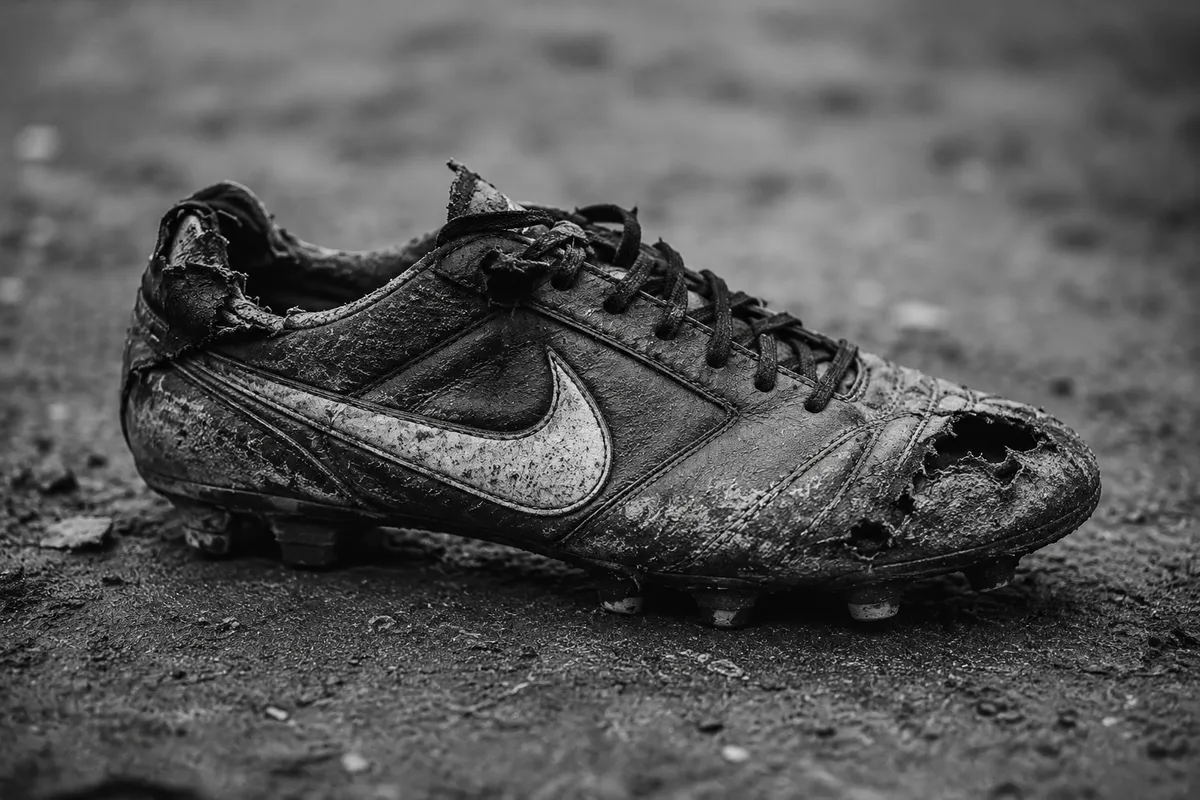
Most parents replace football boots when they look worn out. The boots are scuffed, the upper is cracked, the studs are short and rounded. By that point, according to the research, the boots have probably been ready to replace for some time. The visible surface of a football boot is not a reliable indicator of its structural integrity — the parts that fail first are mostly hidden.
This article is about what actually matters, in the order it matters.
The answer most parents don't expect
For children under twelve, the question "are these boots worn out?" is usually the wrong question. The right question is: have they been outgrown?
Pro:Direct Soccer, the UK's largest specialist football retailer, puts it plainly in their buying guide: "The honest answer is that most children outgrow football boots before they wear them out." The research supports this. Children's feet grow at approximately one to two UK sizes per year between the ages of five and nine — one size every five to seven months on average. A grassroots player training twice a week puts roughly 120–160 hours on a pair of boots over a season, well short of the 400–600 hours at which significant physical degradation typically sets in.
This is worth saying directly because it matters for how you think about second-hand boots. A pair of boots sold by a parent whose child has outgrown them after one season is, structurally, almost certainly in good condition. The boot did not fail. The foot grew.
From around age twelve to thirteen for girls and thirteen to fifteen for boys, the picture starts to shift. Foot growth slows. Training intensity tends to increase. Wear begins to compete with growth as the primary reason a boot needs replacing. For older, more active players — particularly those training four or five sessions a week on artificial turf — the physical condition of the boot becomes the thing to watch.
What wears out first, and why it matters
A football boot is not a single material. It is a collection of components that degrade at different rates and in different ways. When one of them fails, it does not always show on the outside.
The insole is the foam layer your child's foot sits on. It is the first thing that compresses and stops recovering. Research by Verdejo and Mills at the University of Birmingham found that EVA foam — the standard material used in sports footwear insoles and midsoles — shows a doubling of peak plantar pressure after the equivalent of 500 kilometres of running use, meaning the boot is delivering half the cushioning it started with. If you press your thumb firmly into the heel area of the insole and it feels flat and dead rather than springy, the cushioning is gone. In Dubai specifically, heat accelerates this: research published in Materials & Design confirmed that foam softens and loses its energy-return properties at elevated temperatures, and EVA insoles that have been stored in hot cars or dried in direct sun degrade faster than those kept in cool, shaded conditions.
The heel counter is the rigid or semi-rigid cup at the back of the boot that holds the heel in place. When it collapses — pressed in, deformed, no longer holding its shape — the foot is no longer being controlled at the rearfoot. The research on this is clear: when rearfoot control is lost, the ankle and subtalar joint pronate more during loading, which transmits increased stress up the kinetic chain to the knee and creates additional tension on the Achilles tendon and plantar fascia. A collapsed heel counter is not cosmetically damaged boot — it is a boot that is altering your child's movement. Press the heel counter firmly with your thumb: it should resist and spring back. If it stays deformed, the boot needs replacing.
The sole bond — the adhesive join between the upper and the outsole — is particularly vulnerable in a hot climate. Polyurethane adhesives, which are standard in football boot construction, have documented sensitivity to sustained heat exposure. Car interiors in Dubai can reach 60–70°C. Boots left in a kit bag in a hot car are being repeatedly exposed to temperatures that progressively weaken the adhesive bond. The failure usually appears first at the toe, where the boot flexes most with every stride. Run your finger around the full join between upper and outsole. Any lifting, any gap, even a small one, means the bond has begun to fail and will continue to do so.
The studs are the most visible wear indicator, but the research makes clear that the relationship between stud condition and injury risk is more specific than simply "worn is bad." A systematic review and meta-analysis published in the British Journal of Sports Medicine found that higher rotational traction at the shoe-surface interface is associated with approximately double the risk of lower extremity injury. Worn studs reduce translational traction — grip — but the interaction between stud shape and the playing surface is what determines whether that is a safety issue. Rounded, worn studs on firm-ground boots lose penetration into natural grass, reducing grip. On 3G artificial turf, the relationship is different: artificial turf does not yield, and a flat, rounded stud on an abrasive synthetic surface creates unpredictable friction. The Aspetar sports medicine team in Doha, drawing on their specific Gulf-climate experience, recommend that parents check studs regularly and match the boot type to the surface — AG-specification boots for artificial pitches, FG boots only for natural grass.
The upper fails last for most boots, but when it fails in modern lightweight synthetic and knit uppers, it can fail quickly. A split at the toe box — the area that takes most impact during kicking and ground contact — removes the structural protection from the forefoot. Clinical case studies have noted that ultralight knit uppers with no rigid overlay offer very little protection against the loads that transfer into the foot during ball striking. For children playing regularly on artificial turf, knit uppers also tend to pick up abrasion faster than leather or solid synthetic materials, because the turf surface can snag the yarn loops.
The Sever's disease connection
This is the injury link most parents miss. Sever's disease — calcaneal apophysitis, the leading cause of heel pain in children aged eight to fifteen — is explicitly linked to worn-out footwear in the peer-reviewed clinical literature. StatPearls, the clinical reference published by the National Center for Biotechnology Information, lists "poorly cushioned or worn-out athletic shoes" directly among the contributing risk factors. The mechanism is straightforward: the calcaneal growth plate is already under elevated traction stress during a growth spurt. When the boot's heel cushioning has been compressed to the point of losing its shock absorption, that stress increases further. Research has found peak plantar pressure to be ten times higher in children with Sever's disease during walking compared to healthy controls. A boot whose insole no longer cushions is not a neutral object — in a child in the middle of a growth spurt, it is an active contributor to pain.
The Dubai factor
Standard guidance on boot replacement was largely developed for temperate conditions and European seasonal football. Dubai changes several of the variables.
First, year-round play. A typical UK grassroots season runs nine months, with a summer break. Dubai academies run year-round, meaning a child playing twice a week in Dubai logs roughly thirty to forty percent more hours in boots annually than a UK peer on the same schedule. The physical wear threshold is reached sooner.
Second, artificial turf. The overwhelming majority of youth football in Dubai is played on 3G or 4G artificial pitches. Research from Penn State's Center for Sports Surface Research found that synthetic turf surfaces can reach temperatures of 60–75°C in direct summer sun — a figure confirmed by studies in Hong Kong and other warm-climate settings. At these surface temperatures, boot outsoles are subjected to heat loads that accelerate adhesive degradation and material fatigue well beyond what the same boot would experience on natural grass. Multiple retailer and podiatry sources agree that FG boots on artificial turf have their effective lifespan cut roughly in half compared to use on natural grass.
Third, heat and UV. Dubai's UV index regularly reaches ten to eleven — classified as extreme. UV photo-oxidation progressively degrades the polyurethane coatings used in synthetic uppers, causing surface microcracking and embrittlement that begins well before it is visible to the naked eye. Storing boots in the car, drying them in direct sunlight on a balcony, or leaving them by a window accelerates this process. The guidance is simple and directly applicable: store boots indoors, in a cool, shaded place, and never leave them in a car.
The replacement threshold
The hands-on inspection technique — how to check studs, heel cup, sole bond, insole, and upper — is covered in detail in our guide to buying second-hand football boots. The tests are the same whether you're assessing a pair you're about to buy or a pair your child already owns.
What this article adds is not how to check, but when the answer becomes: replace. The threshold for each component is straightforward.
Insole: When pressing your thumb firmly into the heel area feels flat and dead rather than springy, the cushioning is gone. This is the first component to fail and the easiest to identify.
Heel counter: When it stays deformed under thumb pressure rather than springing back, rearfoot support is gone — and unlike a bit of lost cushioning, no amount of wearing them in will bring it back.
Sole bond: At the first sign of any gap between upper and outsole — particularly at the toe, which flexes most — the adhesive bond has begun to fail. It will not arrest itself.
Studs: When the stud profile has worn from its original shape to a flat, rounded disc. On artificial turf, check this more frequently — AG surfaces wear studs faster than natural grass.
Fit: For children under twelve, check this before anything else. If there is less than a thumb's width at the toe — child standing, boot fully laced — replace for size regardless of condition.
The practical summary
For younger children — under twelve, training once or twice a week — the boot is almost always going to be outgrown before it wears out. Checking fit every three to four months is more important than checking for wear. The second-hand market for this age group tends to be supplied by boots in genuinely good condition, because growth, not damage, was the reason for replacement.
For older children and more active players, physical condition starts to matter more. Inspect insole cushioning, heel counter integrity, and sole bond at the start of every season and after any period of high-intensity use. In Dubai — where year-round play, artificial turf, and extreme heat compound faster than in a temperate climate — the conservative guidance from sports podiatrists (replace every season even if the boots look fine on the outside) is reasonable, not overcautious.
Boots that look worn on the outside often still have structural life left. Boots that look fine on the outside are sometimes already compromised in the ways that matter.
Sources
- Verdejo R & Mills NJ (2004). Heel-shoe interactions and the durability of EVA foam running-shoe midsoles. Journal of Biomechanics, 37(9):1379–86.
- Thomson A, Whiteley R & Bleakley C (2015). Higher shoe-surface interaction is associated with doubling of lower extremity injury risk in football codes. British Journal of Sports Medicine, 49(19):1245–52.
- Smith JM & Varacallo MA (2024). Sever Disease (Calcaneal Apophysitis). StatPearls.
- Belikan P et al. (2022). Incidence of calcaneal apophysitis in adolescent athletes of a German youth soccer academy: a retrospective study of 10 years. Journal of Orthopaedic Surgery and Research, 17:83.
- Shariatmadari MR et al. (2012). Effects of temperature on the material characteristics of midsole and insole footwear foams subject to quasi-static compressive and shear force loading. Materials & Design, 37:543–559.
- Kinoshita H & Bates BT (1996). The effect of environmental temperature on the properties of running shoes. Journal of Applied Biomechanics, 12(2):258–268.
- Penn State Center for Sports Surface Research — Surface temperatures of synthetic turf.
- Loud E et al. (2024). Outsole configuration and traction on natural and artificial grass. Orthopaedic Journal of Sports Medicine.
- Thomson A et al. (2021). What football boot is best for me? Aspetar Sports Medicine Journal.
- Praxis Health (2024). Football boots: a sports podiatry perspective.
- Pro:Direct Soccer. Kids' football boots buying guide.