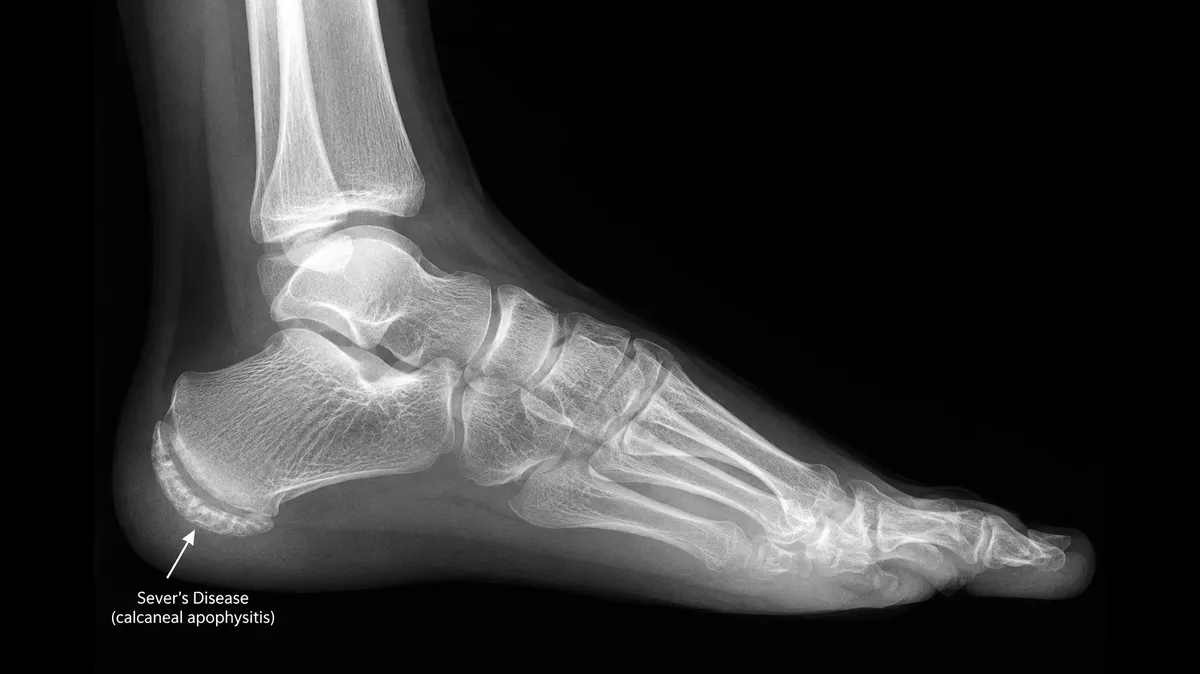
Sever's disease is the most common cause of heel pain in children aged eight to fifteen. In a busy youth sports club, it is not unusual for several players to have it at the same time, quietly causing limps and early pitch exits that parents often put down to general soreness or tiredness.
It is not a disease in the way the name suggests. It is not contagious, not a structural defect, and not something that causes lasting damage. It is a growth plate injury — specifically, inflammation at the calcaneal apophysis, the growth plate at the back of the heel bone — and it is almost always temporary. (The same problem at the knee, where the big thigh tendon tugs on its growth plate, is Osgood-Schlatter.)
Understanding what causes it makes the management straightforward.
Why it happens
During a growth spurt, the heel bone (the calcaneus) lengthens faster than the Achilles tendon attached to it. The result is a tendon that is, relatively speaking, too short for the bone it connects to. Every stride, jump, and sprint creates tension at the point where the Achilles meets the heel — right at the growth plate. Repeated over a season of twice-weekly training and weekend matches, that traction causes inflammation.
Growth plates are vulnerable in ways that adult bone is not. They are active zones of cell division — the mechanism by which the bone grows — and they are made of cartilage, which is softer and more susceptible to stress than mature bone. Inflammation here is the body's signal that load has exceeded the growth plate's capacity to recover.
Boys are affected more often than girls, typically between 10 and 15. Girls tend to experience it earlier, around 8 to 13, because they enter growth spurts sooner. The timing tracks almost exactly with the periods of fastest growth — which is why it often appears suddenly in a child who was training without problems the previous season.
What it feels like
The hallmark symptom is pain at the back or bottom of the heel, which worsens during sport and eases with rest. A reliable clinical test is the squeeze test: gentle pressure applied to both sides of the heel simultaneously. In a child with Sever's, this produces the characteristic pain.
Morning stiffness — a child walking awkwardly for a few minutes after getting up — is common. So is a slight limp during or after training that clears up with a day or two of rest, only to return at the next session. The condition is typically diagnosed clinically, from the symptoms and the squeeze test alone. X-rays are rarely needed and are usually unremarkable, because the injury is in soft tissue rather than bone.
The footwear connection
Footwear is not the cause of Sever's — the cause is growth. But footwear affects how much load reaches the growth plate on every stride, and that matters considerably.
Cushioning that has degraded. A training shoe that has lost its midsole responsiveness passes more impact force into the heel than a fresh pair. EVA foam — the material in most children's training shoes — degrades meaningfully after a full season of daily wear. If a child develops heel pain mid-season, checking the shoe's midsole by pressing it firmly with a thumb is worth doing. If it offers almost no resistance, the cushioning has gone.
Football boots without adequate heel protection. Firm ground and soft ground boots are engineered for traction, not impact absorption. The thin midsole that makes them feel responsive on grass offers very little cushioning compared to a training shoe. Children training heavily in boots several times per week are absorbing repeated impact on a thin sole — and if a growth spurt has tightened the Achilles, that combination is a common trigger for Sever's. Heel cups inserted into the boot reduce the load significantly and are worth trying before doing anything more involved.
Shoes that are too large. A shoe that is too big causes the heel to slide with each stride, changing the mechanical loading at the back of the foot. In a child already dealing with Achilles tightness, the added instability of a loose heel cup makes things worse. Getting the fit right matters here for reasons beyond comfort.
What actually helps
Sever's responds well to conservative management.
Relative rest. Complete rest is rarely necessary. Reducing training load — avoiding activities that cause peak pain (jumping, sprint work, hard surfaces) — allows the inflammation to settle while keeping the child active. Returning too quickly before the pain resolves is the most common reason for a prolonged recovery.
Calf and Achilles stretching. Since the underlying mechanism is Achilles tightness relative to bone length, stretching the calf reduces the traction force on the growth plate. Simple calf stretches, done regularly, are one of the most consistently effective interventions. A physiotherapist can advise on a programme appropriate for your child's age and activity level.
Heel cups or cushioned insoles. Silicone heel cups absorb some of the impact that would otherwise reach the growth plate. Inexpensive and widely available, they work best inside a well-fitted training shoe.
Reviewing boots and training surfaces. If the child is training heavily in football boots, consider whether some sessions could be done in training shoes. Reducing time on thin-soled boots during a flare can make a meaningful difference.
The thing worth saying clearly: Sever's disease almost always resolves completely once the growth plate fuses, typically in the mid-teens. The child who limped off the pitch at twelve will, in all likelihood, be running without issue at sixteen.
Sources: Sever JW (1912), Journal of the American Medical Association — original clinical description · American Academy of Pediatrics: clinical guidance on calcaneal apophysitis · James AM et al. (2013), Journal of Paediatrics and Child Health — Sever's disease epidemiology and management in young athletes