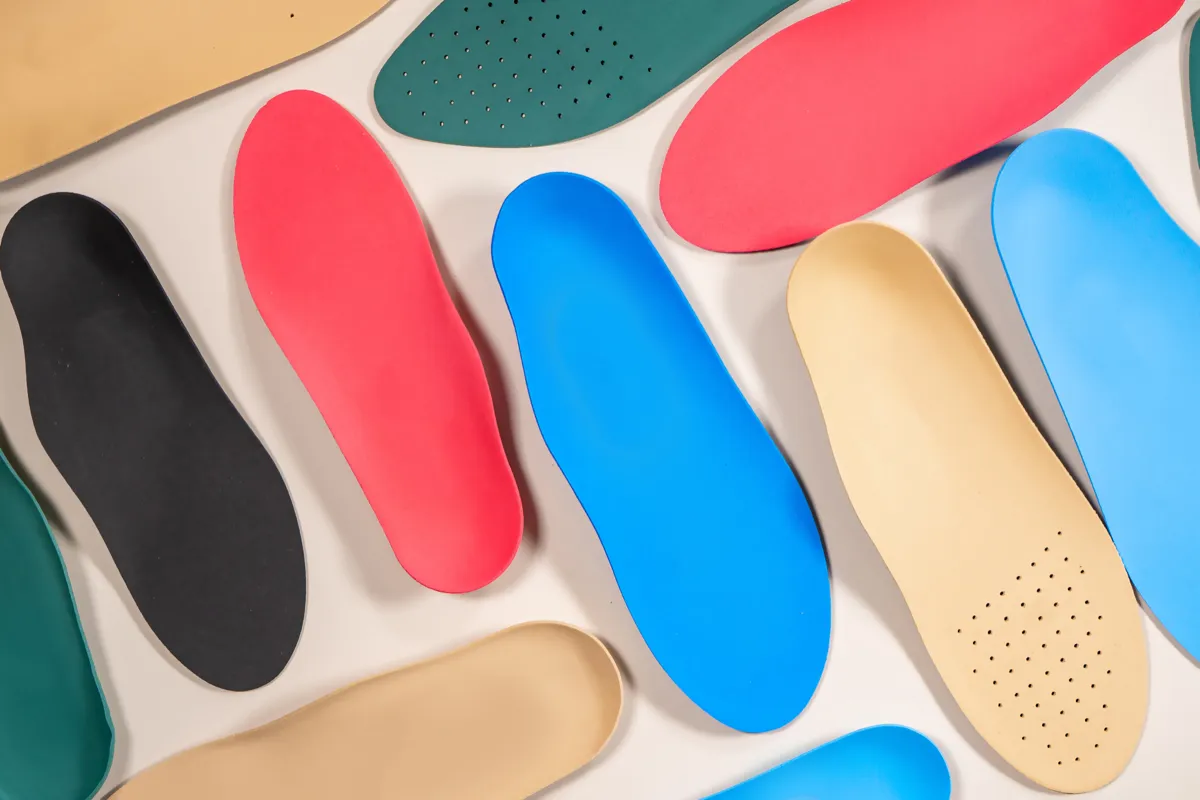
"My child has flat feet — do they need special shoes?" is, by a significant margin, the most Googled question about children's foot health. The commercial answer and the clinical answer are not the same thing. The commercial answer — arch support insoles, corrective footwear, rigid orthotics — is pushed hard by shoe brands and insole companies with a financial interest in the diagnosis. The clinical answer, which is what the published research actually says, is rather different.
This article is the clinical answer.
Almost every toddler has flat feet
Start with the developmental baseline. Flat feet in young children are not a medical problem. They are the normal starting condition of the human foot.
At age two, approximately 95–100% of children have flat feet. At age three, roughly 54% still do. By age six, that figure is around 24%. By age ten, it's approximately 4%. This is the natural trajectory, documented across hundreds of studies, most recently confirmed in a 2017 systematic review of 34 epidemiological papers covering 19 countries.
Two things explain why toddlers are universally flat-footed. First, a fat pad sits along the inner edge of the foot in infancy, filling what will eventually become the arch space. Second, the ligaments of a young child's foot are highly lax — the foot simply collapses under body weight. Both features resolve naturally across the first decade of life, and the arch develops as the muscles, ligaments, and bones mature.
The key phrase in that trajectory is "without intervention." The research isn't measuring children who were treated with insoles or corrective shoes against a baseline. It's measuring children who were left alone. The arch, in the vast majority of cases, forms on its own.
The research on arch support
In 1989, a landmark study at the University of California randomised 129 children into four groups: no treatment, orthopaedic shoes, a heel cup, and a custom moulded plastic insert. Minimum treatment period was three years. The conclusion: "Wearing corrective shoes or inserts for three years does not influence the course of flexible flatfoot in children." Children across all four groups — including controls who received nothing — showed equivalent improvement.
That study has never been overturned. It was confirmed by a Cochrane systematic review in 2022 that analysed 16 randomised controlled trials involving 1,058 children across nine countries. The conclusion: in asymptomatic healthy children with flat feet, foot orthoses — whether custom-made or off-the-shelf — show no significant benefit over shoes alone on pain, function, or quality of life.
The American Academy of Pediatrics, the AAFP, the NHS, and the Paediatric Orthopaedic Society of North America all state the same thing: do not prescribe custom orthotics for a child with asymptomatic flat feet. The NHS is direct: "Insoles do not change the shape of feet or form arches."
It also bears saying: only 1–2% of children with flat feet are ever symptomatic. Research suggests that around 10% of American children with flat feet are treated with orthoses. Which means the overwhelming majority of treatments are being given to children who never needed them.
The difference between flexible and rigid flat feet
There is a distinction worth understanding, because it defines the small proportion of children who do need clinical attention.
Flexible flat feet — which represent the vast majority of cases — are those where the arch disappears under body weight but reappears when the foot is unloaded. Have your child stand normally: no arch visible. Have them sit and lift their foot, or stand on tiptoe: the arch appears. This is physiological. It is the developmental norm. It does not require treatment.
Rigid flat feet are those where the arch is absent in all positions — weight-bearing and non-weight-bearing alike. The foot cannot be moved freely from side to side. This is structurally different, uncommon (less than 1% of children), and warrants a clinical assessment.
The signs that should prompt you to speak to a podiatrist or paediatrician:
- The flat foot is painful, or your child is reluctant to walk, run, or keep up with their peers
- Only one foot is flat (asymmetrical presentation is a red flag; physiological flat feet are bilateral)
- The foot is rigid — it doesn't reconstitute any arch at all when your child stands on tiptoe
- Your child is over eight years old, still completely flat-footed, and experiencing discomfort
- The flat foot appeared suddenly after previously normal arch development
None of the above are reasons to panic. They are reasons to get a professional opinion. The absence of any of the above in a child under eight with flat feet is generally not a reason to do anything at all.
What footwear actually does
The research on footwear is more nuanced than the research on orthotics, but the directional signal is consistent.
A 1992 study of 2,300 Indian children found that flat foot prevalence was 8.6% in children who wore closed shoes, compared to 2.8% in children who went unshod — a threefold difference. Sandal wearers sat in the middle. A large 2017 study comparing children who habitually walked barefoot (in South Africa) with those who habitually wore shoes (in Germany) found that the barefoot children had higher, more pliable arches and better overall foot morphology across all ages studied.
The mechanism isn't mysterious. A bare or minimally covered foot activates the intrinsic muscles of the foot — the small muscles that support and shape the arch — far more than a rigid shoe, which passively absorbs the load. A foot that doesn't have to work tends to work less. A foot that has to work develops the structures that let it do so.
Practical implications for parents:
Flexible soles are better than rigid ones. A child's everyday shoe should flex easily across the forefoot — if you can't fold the front third of the shoe upward with moderate hand pressure, it's too stiff. Research comparing conventional and flexible shoes found that even flexible shoes reduce natural foot motion compared to barefoot, but the reduction is meaningfully less than with rigid shoes.
Barefoot time matters. At home, on grass, on sand — barefoot exposure is developmentally useful, not dangerous. In a Dubai context, the traditional indoor norm of removing shoes at the door and walking barefoot or in soft slippers is, from a foot development perspective, a sound one.
Narrow toe boxes are a problem. Multiple studies have found that the majority of children's shoes on the market are too narrow for children's feet. A shoe that compresses the toes prevents them from spreading naturally under load — and the toes play an active role in arch stabilisation. The toe box should be wide enough for the toes to lie flat and splay slightly.
Arch support insoles do not build arches. They may relieve discomfort in a symptomatic child. They do not, based on the research evidence available, influence the underlying architecture of the developing foot.
The Dubai dimension
There is no published prevalence study specific to UAE children, which is a gap in the literature. The closest regional data comes from Saudi Arabia, where a study of 403 children aged 7–14 found a flat foot prevalence of around 29.5% using a standard clinical measure — higher than many European studies, but largely explained by the same risk factors seen globally.
The strongest modifiable risk factor for flat feet that persist beyond childhood is, consistently, obesity. Children who are overweight are roughly 3.5 times more likely to have flat feet that don't self-resolve. Dubai's Indian expatriate school population has notably elevated rates of childhood overweight — a 2024 study at one Dubai school found over 37% of students were above the 85th BMI percentile. This is a relevant context for any parent in Dubai thinking about their child's foot health, regardless of what they do about footwear.
The traditional Gulf approach of wearing sandals and removing shoes indoors is, from a foot health perspective, close to optimal. The risk comes from well-intentioned interventions — rigid sports shoes worn all day, arch support insoles fitted prophylactically — that the clinical evidence does not support.
The practical summary
Most flat feet in children under eight are a developmental stage, not a condition. The arch will form on its own. Orthotics and corrective footwear do not accelerate this process and are not recommended for children who have no symptoms. If your child has flat feet and is running around without pain, sleeping fine, and keeping up with their peers, the evidence-based response is to do nothing except let them grow.
If there is pain, asymmetry, or a rigid foot that doesn't reconstitute an arch on tiptoe, that is worth getting looked at — not because it's likely to be serious, but because those specific presentations can occasionally indicate a structural issue that warrants assessment.
For footwear: flexible sole, wide toe box, and as much barefoot time as is practical. The foot develops by being used, not by being supported.
Sources
- Pfeiffer M et al. (2006). Prevalence of flat foot in preschool-aged children. Pediatrics, 118(2):634.
- Staheli LT et al. (1987). The longitudinal arch. J Bone Joint Surg Am, 69:426.
- Wenger DR et al. (1989). Corrective shoes and inserts as treatment for flexible flatfoot. J Bone Joint Surg Am, 71(6):800.
- Mosca VS (2010). Flexible flatfoot in children and adolescents. J Child Orthop, 4(2):107.
- Halabchi F et al. (2013). Pediatric flexible flatfoot. Iran J Pediatr, 23(3):247.
- Uden H et al. (2017). The typically developing paediatric foot. J Foot Ankle Res, 10:37.
- Evans AM et al. (2022). Foot orthoses for treating paediatric flat feet. Cochrane Database Syst Rev.
- AAFP/AAP Choosing Wisely — no orthotics for asymptomatic flat feet.
- NHS Guy's & St Thomas' (2024). Flat feet in children.
- Rao UB & Joseph B (1992). The influence of footwear on the prevalence of flat foot. J Bone Joint Surg Br, 74-B(4).
- Hollander K et al. (2017). Growing up (habitually) barefoot influences foot and arch morphology. Scientific Reports, 7:8079.
- Wolf S et al. (2008). Foot motion in children shoes. Gait & Posture, 26(1).
- Pandey S et al. (2024). Childhood obesity in Indian expat students in Dubai. Cureus.
- Moore J & Tafti D (2026). Pes Planus. StatPearls.