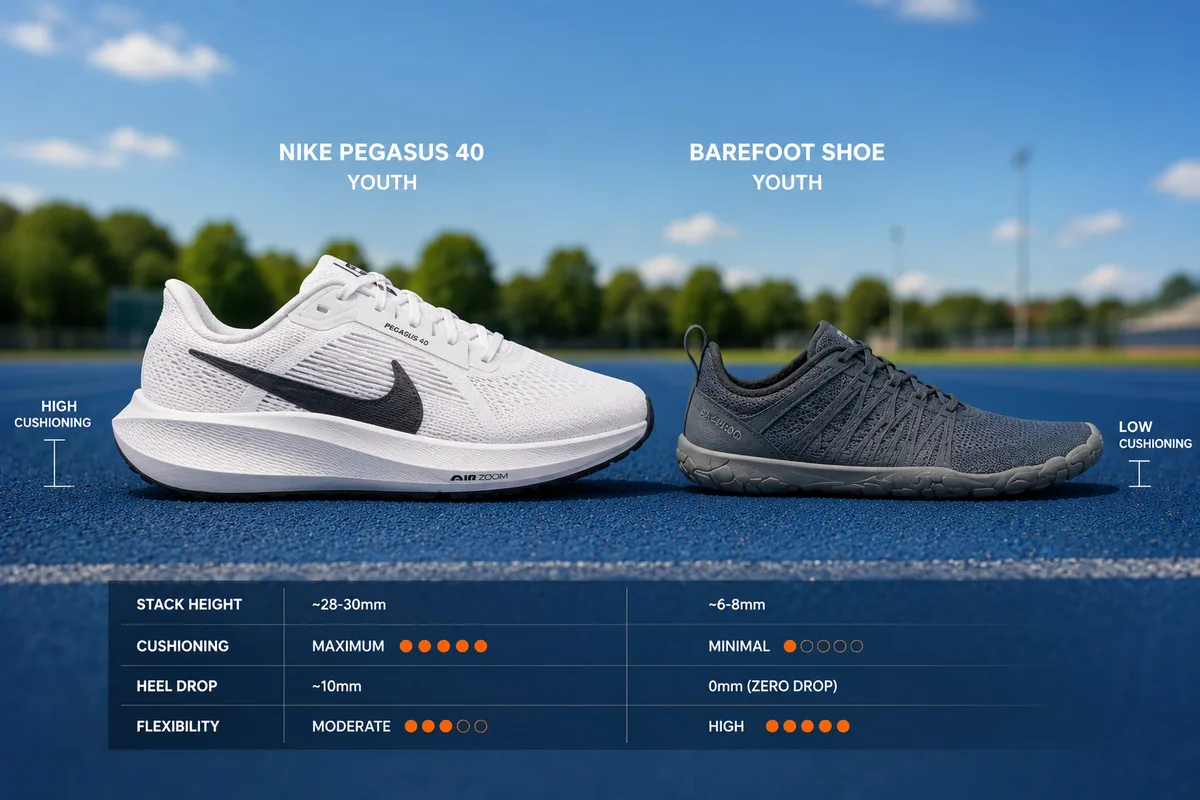
Walk into a shop to buy your child a pair of running shoes and you'll be pulled in two opposite directions. On one wall, barefoot and minimalist shoes — almost no sole, sold on the promise of "natural" movement and strong feet. On the other, maximalist shoes — great slabs of foam, sold on the promise of plush, joint-saving protection. Both are now made in children's sizes. Both are marketed hard. And they cannot both be right.
The honest answer, which suits neither sales pitch, is that for most children most of the time the right place is somewhere in the unglamorous middle. Here's why — because the reasons both extremes fall short are more interesting than the marketing on either side.
The two ends of the spectrum
Picture a line. At one end, nothing under the foot — barefoot and minimalist shoes. At the other, as much foam as will fit — maximalist shoes. Conventional everyday trainers sit in between. The instinct most parents have is that the safe choice for a growing child must be toward the cushioned end: more padding, more protection. The evidence doesn't support that instinct. It also doesn't support rushing to the other end. Each extreme has a catch, and understanding both is what tells you where your child actually belongs on the line.
The minimal end: real benefit, with a sharp condition
There's a genuine case for less shoe — and we've made it before, in our article on flat feet. Time spent barefoot or in minimal footwear makes the small muscles of the foot work, and a foot that works builds strength, arch and balance. Children who grow up habitually barefoot tend to have stronger, more pliable feet than those who are always shod. For everyday play — at home, on grass, on sand — less shoe is developmentally useful, not risky. The studies behind this are smaller and shorter than you'd like, but they point consistently the same way.
The catch arrives the moment you take that minimal foot and ask it to run hard. With little or no cushioning, the shock of each footstrike that the foam would normally take is passed to the foot and leg instead. Research on young runners aged eight to fourteen has found that barefoot and minimal-shoe running can roughly double the rate at which impact load is applied compared with cushioned shoes. A developing body can adapt to that — the foot, tendons and bones do strengthen to meet the demand — but only if it is given time. When runners switch to minimalist shoes quickly, the injury data is blunt: a well-known study tracking runners over a ten-week transition found significantly more bone-marrow swelling and stress injuries in the feet of those who made the change than in those who stayed in conventional shoes. The advice from every quarter is the same — any move toward minimal must be slow, measured in months not weeks, at low volume.
So minimal is excellent for everyday development and play, and risky as a quick switch into serious running. Those are two different uses, and blurring them is where the trouble starts.
The maximal end: the cushioning paradox
The cushioned end looks like the cautious choice. It isn't quite, and this is the part that surprises people.
A 2018 study published in Scientific Reports compared runners in highly cushioned shoes against conventional ones and found the opposite of what the foam promises: the maximalist shoes increased leg stiffness and amplified impact loading — impact peak up around 10.7% and loading rate up around 12.3% at speed. The suspected reason is the same sense we keep coming back to: cushioning dulls the foot's feel for the ground, so the leg lands stiffer to compensate, and a stiffer landing drives more force, not less. Researchers call it the cushioning paradox — shoes have grown thicker for decades, and running injuries have not fallen to match.
For a child, there's a second problem on top of the first. A thick wedge of foam removes exactly the ground feel a developing foot relies on to build strength and the reflexes that protect it — the same reason podiatric guidance for children favours flexible, lightweight shoes over stiff or heavily built ones, and the same reason we argued against carbon-plated "super shoes" for kids. Maximal cushioning is, in its own way, another case of too much shoe.
Why both extremes fail for the same reason
Strip the protection away before the foot is ready for it, or bury the foot's senses under foam, and you arrive at the same outcome from opposite directions: a stiffer, less-adapted landing and more load where you don't want it. It comes back to one fact about children that no shoe can shortcut — the foot is still being built, and it builds by feeling the ground and doing its own work. A child's own foot is the most sophisticated cushioning system they will ever own, and at this age it is still under construction. The shoe's job is to protect it without taking the work away.
The middle, and what to actually look for
For most children, in most sports, the shoe that does that job is the unremarkable one: a moderate, flexible trainer that fits properly, lets the foot feel the ground, and is light. Bend it in your hands — it should flex easily across the forefoot, not resist like a plank. Check there's a thumb's width at the toe with the child standing (our fit guides cover this in detail). Match it to the surface and the sport. That shoe will do more for a developing foot than any amount of foam or any "natural" minimalism, and it costs less than both.
The Dubai dimension
Two local factors pull in opposite directions, and both are worth knowing.
The one real argument for some cushioning is the ground here. Most youth sport in Dubai happens on unforgiving surfaces — 3G artificial turf that stiffens as it ages, pavement, dry compacted pitches, indoor courts. On surfaces with no give, a shoe's cushioning does genuine work, and a still-developing foot can't yet do all of that work itself. This is exactly why pushing a young runner toward fully minimal shoes deserves extra caution in the UAE, and why any transition should start off the hardest surfaces.
The argument against paying for maximum cushioning is the heat. Foam softens and loses its bounce at high temperatures, and UV light makes it brittle over time — a shoe left in a hot car or drying in direct sun degrades faster than one kept cool and shaded. An expensive maximal midsole here loses condition quickly, and a child will usually outgrow it long before its premium has paid for itself. Store sports shoes somewhere cool and out of the sun, and don't over-invest in foam that won't last the season.
The practical version
For most children and most sports: a moderate, flexible, well-fitting shoe matched to the surface — plus plenty of barefoot and play time off the pitch, where the developmental benefit of minimal actually lives.
If you want to move a young runner toward minimalist shoes: go slowly, over months not weeks, at low mileage, and keep them off the hardest surfaces while the foot adapts.
Skip the extremes for the years that matter most: maximal-stack shoes and carbon-plated racers can both wait until the mid-teens at the earliest.
And whatever you choose, remember the foam is the part everyone argues about and rarely the part that matters most. Fit and condition decide far more — which is the cheaper, duller truth underneath the whole debate.
Sources
- Kulmala JP, Kosonen J, Nurminen J & Avela J (2018). Running in highly cushioned shoes increases leg stiffness and amplifies impact loading. Scientific Reports, 8:17496.
- Oregon State University FORCE Lab — impact loading in barefoot and minimal-shoe running in youth athletes (ages 8–14).
- Transition study on minimalist running shoes — increased bone-marrow oedema and stress injury over a 10-week switch (published in Medicine & Science in Sports & Exercise).
- Footwear guidelines for healthy children and adolescents — rapid scoping review recommending flexible, lightweight footwear.