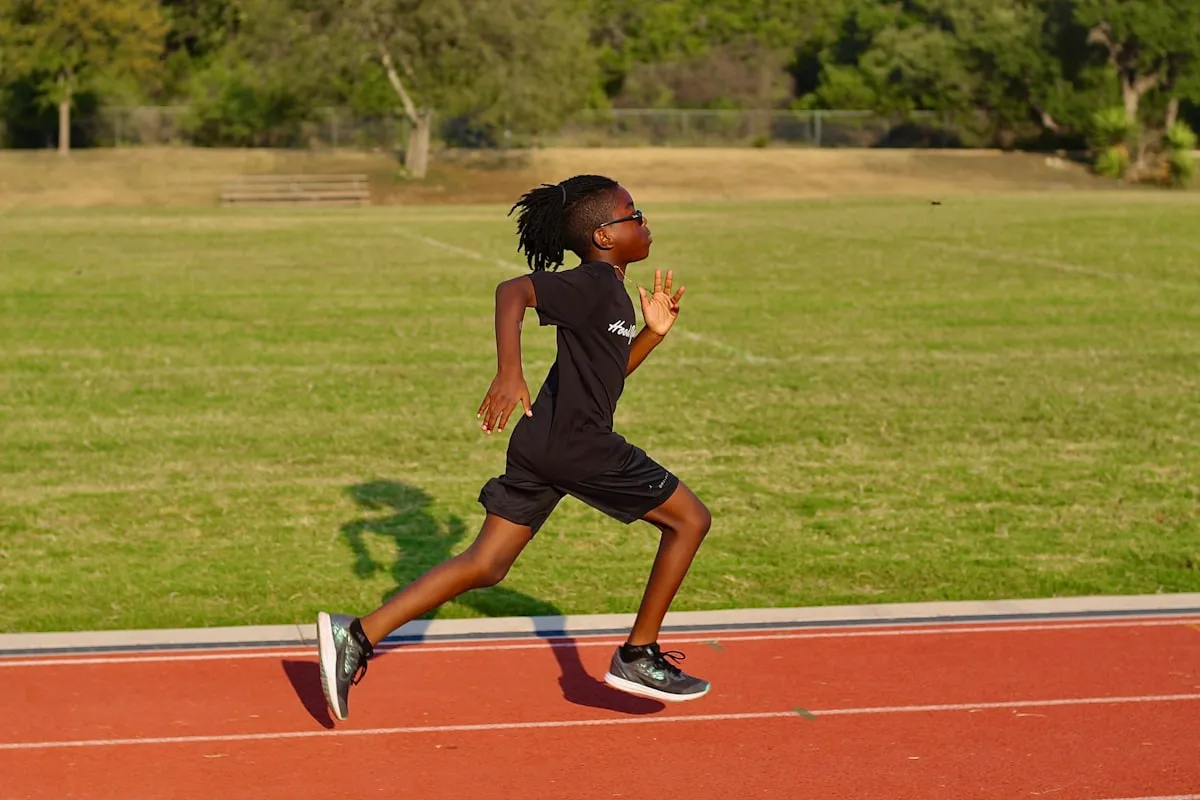
The Nike Vaporfly. The Adidas Adizero Adios Pro. The ASICS Metaspeed Sky. These are the shoes that have rewritten marathon records and packed the podiums of major races. They are also, increasingly, available in children's sizes — because if a technology works, it gets miniaturised and sold to everyone.
Which raises a question that's better answered by a biomechanist than a shoe retailer: should children actually wear them?
The honest answer is: almost certainly not, below the mid-teens. Here's why.
Why super shoes work for adults
The mechanism behind elite running shoes is well understood now. A highly resilient PEBA foam midsole stores and returns energy at 80–87%, compared to 60–65% for conventional foam. A stiff carbon fibre plate acts as a lever arm, reducing the muscular work required at the toe and ankle with each stride. Together, the combination reduces how much mechanical work the body has to do at any given pace — improving running economy by 2–4% in trained adult runners, according to multiple independent studies.
For an adult who already runs with developed strength, stable joint mechanics, and a mature gait pattern, this is genuinely useful. Less energy lost per stride means faster racing and reduced fatigue over distance. The technology is not marketing fiction. It works.
The problem is that children are not small adults. They are developing organisms. And the biomechanics of development change the equation considerably.
How children's feet actually work
The bones of the foot do not fully ossify — harden from cartilage into bone — until the late teenage years. In younger children, the growth plates at the ends of bones are active zones of cell division, vulnerable to stress in ways that adult bone is not. The muscles, tendons, and ligaments around those bones are still building the capacity they'll rely on for the rest of their lives.
This is why podiatrists, physiotherapists, and sports medicine clinicians consistently recommend flexible, lightweight footwear for children. The foot needs to feel the ground in order to develop proprioception — the body's sense of position in space. It needs to flex and move naturally to build the intrinsic muscle strength the foot relies on later. Stiffer, more constrained footwear reduces the sensory stimulus that drives that development.
A 2023 systematic review examining children's footwear guidelines found that 13 of 14 studies and clinical guidelines recommended flexible soles for children. The overall conclusion across study populations: stiff and compressive footwear may cause deformity, weakness, and loss of mobility in developing feet. Flexible beats stiff, ground-feel beats cushioning, function beats technology.
What happens when you add a rigid plate
A carbon plate's value in an adult racing shoe comes precisely from its stiffness: it limits the natural flex of the toe joint, reduces muscular work, and guides the foot through an efficient push-off pattern. For a developing foot, each of those properties is a problem rather than a benefit.
Research published in 2022 specifically examined how high longitudinal bending stiffness — the biomechanical property that makes carbon plates effective — affected adolescent runners. The findings were clear. Compared to more flexible footwear, the stiff shoes increased ground contact time by approximately 15%, reduced range of motion at the hip and metatarsophalangeal joint, and increased the activation demand on the quadriceps and foot flexor muscles. The researchers concluded that high-stiffness footwear was not appropriate for young runners, and that lower stiffness better matched adolescent biomechanical capability.
The mechanism of concern is not complicated. A rigid plate removes a developmental stimulus — the natural toe flex that progressively builds foot and calf strength over years of activity. It replaces that stimulus with a mechanical constraint, shifting load onto tissues that haven't yet been conditioned to handle it. The Achilles tendon, already under significant developmental stress in active adolescents, is a specific concern. Clinicians have flagged elevated Achilles load as a meaningful risk with highly stiff footwear in younger runners.
There is also a gait development angle. Carbon plate shoes are engineered around a specific, high-efficiency adult running pattern. Children are still forming their gait. Introducing a shoe that mechanically channels and constrains movement before that pattern has developed naturally may be, at minimum, unnecessary. At worst, it interrupts a developmental process that works better without interference.
What the evidence doesn't yet say
To be fair: the research here is newer and thinner than the adult performance literature. There are no long-term studies tracking injury rates in children who grew up wearing carbon-plated shoes versus those who did not. No one has definitively proved that a 10-year-old wearing super shoes for a school cross-country race is headed for a specific injury.
But the convergence of pediatric footwear research, adolescent biomechanics data, and clinical guidance all point in the same direction. The absence of long-term harm data is not the same as evidence of safety. And given that developing feet do not need propulsive assistance — they need sensory input, flexibility, and room to strengthen — the precautionary case is strong.
Most sports podiatrists draw the line somewhere around 14–16 years for serious consideration of plated racing shoes, and even then, for race day only, not training. Below that age, the answer to "does my child need super shoes?" is consistently the same: no.
What children actually need from a sports shoe
The good news is that the criteria for an excellent children's sports shoe are simpler, and the shoes far cheaper.
Fit is everything. A shoe that doesn't fit causes more problems than any midsole technology can compensate for. Toes need room. The heel should be secure. For children under ten, foot length should be rechecked every two to three months — growth at this age is quick, and a tight shoe is a common and entirely avoidable source of foot problems.
Flex the forefoot. Hold the shoe and bend it. If it resists significantly, it is too stiff for most children in most situations.
Match the surface. Football boots on firm ground. Astros on 3G. Running shoes on road. The right shoe for the activity protects joints more meaningfully than any foam technology.
Light over heavy. Heavier shoes reduce proprioceptive feedback and add unnecessary load for growing legs. Lighter is generally better.
The foam wars and the carbon plate debates are genuinely fascinating corners of materials science and biomechanics. They matter enormously to adult runners optimising for race performance. For your child, the thing that matters most is whether the shoe fits, suits their sport, and lets their foot do what feet need to do at their age.
The super shoe can wait.
Sources: PMC9437943 — Effects of footwear longitudinal bending stiffness on biomechanics in adolescent runners · PMC12249973 — Guidelines for Recommended Footwear for Healthy Children and Adolescents: A Rapid Scoping Review · PMC10218108 — Understanding the Role of Children's Footwear on Gait Development: A Systematic Scoping Review · Hoogkamer et al. 2018, University of Colorado