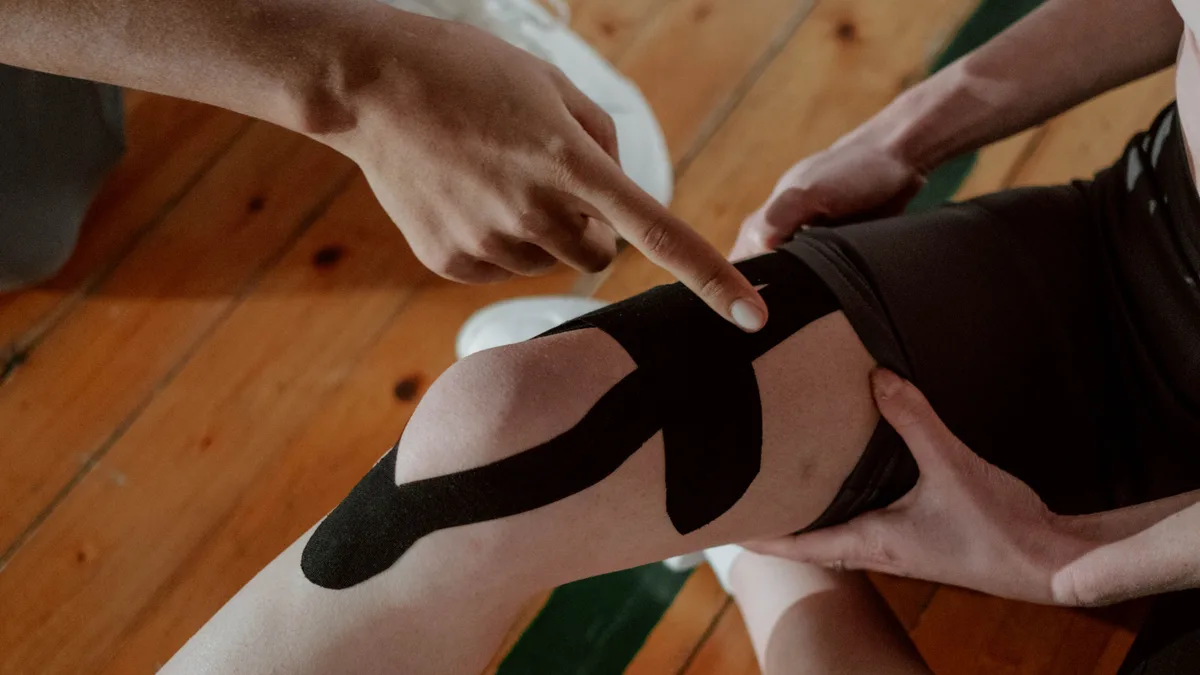
If your child plays a lot of sport and has started complaining of pain — and grown a tender bump — just below the kneecap, there's a good chance it's Osgood-Schlatter. It is one of the most common causes of knee pain in active children, it looks alarming (a hard lump on the top of the shin), and the reassuring headline is this: it is almost always harmless and temporary. It is still worth understanding, because how you handle it decides whether your child manages a niggle or ends up sidelined — and because, very occasionally, knee pain is something that needs urgent attention.
It is, in effect, the knee's version of a problem we've written about at the other end of the leg. Sever's disease causes heel pain; Osgood-Schlatter causes knee pain. Both are traction apophysitis — the same mechanism, a different growth plate.
What it actually is
The patellar tendon runs from the kneecap down to a bump at the top of the shin called the tibial tubercle, where the powerful thigh muscle anchors. In a growing child that anchor point isn't solid bone yet — it's a growth plate (an apophysis), made of softer cartilage. Every sprint, jump, kick and deep squat, the thigh muscle hauls the tendon against that soft attachment. Repeated across a season — and especially during a growth spurt — the area becomes irritated and inflamed, producing pain, some swelling, and the characteristic bony lump.
It is not a disease in the frightening sense. It is not contagious, it is not a tumour, and it does not damage the knee joint. It is a growth-related overload injury that settles once the area finishes hardening into mature bone.
Why it happens, and who gets it
The driver is growth plus load. The force through the tendon rises with activity and rises further after a rapid growth spurt, when the bone lengthens ahead of the muscle and tendon and leaves everything tight — the same growth-spurt mechanism behind Sever's and shin splints.
It is common. Roughly one in ten athletic adolescents is affected — around 9.8% of twelve-to-fifteen-year-olds in one large sample. The split with non-athletes is stark: about 21% of young athletes versus 4.5% of non-athletic peers. The sports most strongly linked are the stop-start, jumping and kicking ones — football and basketball above all.
The timing tracks puberty, so it arrives earlier in girls (typically around 10–11, sometimes from 8) than boys (typically 13–14, sometimes from 12). It has historically been more common in boys, though it is increasingly seen in girls as girls' sport participation grows. Both knees are affected in 20–30% of cases.
What it feels like
The pain comes on gradually, not from a single injury, and it points to one spot: the bump just below the kneecap. That spot is tender to press, often visibly raised, and the pain is worse with running, jumping, kneeling, squatting and stairs, and better with rest. Kneeling straight onto it is particularly sore.
It is diagnosed clinically — from where it hurts, the activity pattern, and the tenderness over the tubercle. X-rays are usually unnecessary, and are used only to rule out other causes or after an acute injury.
When it is not just Osgood-Schlatter
This is the part to read twice. The condition itself is benign, but a few situations need a doctor — some of them urgently.
The serious one: a sudden, severe knee injury during a jump or landing — intense pain, a knee that looks deformed, a kneecap that sits oddly high, and a child who can't straighten the leg or take weight on it. A growth area already stressed by Osgood-Schlatter can, rarely, pull clean off as a tibial tubercle avulsion fracture. That is an emergency — go to A&E, don't wait.
Get it seen promptly, too, if there is pain at rest or at night, a hot or swollen knee or a fever (to rule out infection), the knee locking or giving way, or pain that isn't at the bump. Those point away from ordinary Osgood-Schlatter. As a general rule, knee pain that is getting worse, not settling, or stopping normal activity deserves a professional opinion. Telling it apart from similar conditions — such as Sinding-Larsen-Johansson, the same kind of problem at the bottom of the kneecap — is a job for a clinician, not a worry for you to resolve at home.
What helps
For ordinary Osgood-Schlatter, the management is conservative and effective — and it is mostly about load, not rest.
Manage the load, don't stop everything. The aim is to dial the aggravating activities — jumping, sprinting, deep squats — down to a level the knee tolerates while keeping your child active. Most children can keep playing in a managed way; completely stopping sport is rarely necessary, and charging back to full load before the pain settles is the usual reason it drags on.
Ice and simple pain relief help with flare-ups after activity.
Strength and flexibility. Stretching the quadriceps and hamstrings, plus physiotherapy-guided strengthening (eccentric quad work and hip and core stability), is the backbone of recovery. The approach with the most promising results is a graded "activity ladder" — a structured, pain-guided return that rebuilds load step by step.
On straps and braces: the infrapatellar strap is widely used and some children find it comfortable, but be clear-eyed about it — there is no good evidence it changes the course of the condition. It is a comfort aid, not a substitute for managing the load.
It's worth saying plainly, in the Lab's usual spirit: the evidence base for these programmes is thinner than you'd expect — largely clinical experience and cohort studies, with proper trials still ongoing. What is well established is that the condition settles with time and sensible loading; the fine detail of the "best" programme is less settled, which is exactly why a physiotherapist tailoring it to your child is worth more than any generic plan.
The reassuring part: it almost always resolves as the growth plate matures, usually within one to two years and by around age 18. The bony bump may remain for good — usually harmless, occasionally a nuisance when kneeling. In about one in ten cases some symptoms linger into adulthood, and that is most common where it was pushed through without management — which is the real argument for taking it seriously now.
Where footwear comes in (a small part, honestly)
Unlike heel pain, Osgood-Schlatter is not a footwear problem. It is a knee-and-thigh traction problem, and no shoe will fix it — we'd be overselling to suggest otherwise. The honest connection is only this: anything that reduces the total impact load on a growing leg helps a little, so cushioning that hasn't gone flat (our guide to replacing running shoes covers how to tell), the right shoe for the surface, and not piling hard, dead-soled mileage on top are all worth getting right. They are minor levers, though. Load and strength are the main ones.
The Dubai dimension
The two sports most strongly linked to Osgood-Schlatter — football and basketball — are exactly the ones children here play hardest, on hard surfaces, all year. A sport calendar with no real off-season means the load that drives the condition never lets up through the growth years — the same problem we set out in our piece on how much running is too much for children. The single most useful thing a parent can do is also the one academy culture makes hardest: build in genuine rest and ease the load through growth spurts, rather than training straight through them.
The takeaway
Osgood-Schlatter looks worse than it is — a tender bump that worries parents and almost always fades with time and sensible load management. Two things matter most: don't let a child push through worsening knee pain, and treat any sudden, severe knee injury as an emergency rather than "just the bump." Manage the load now, and the overwhelming majority are running, jumping and kicking perfectly well by their mid-teens.
Sources: Smith JM & Varacallo M — Osgood-Schlatter Disease, StatPearls (NCBI) — pathophysiology, epidemiology (≈9.8% of adolescents; bilateral 20–30%), diagnosis and complications · "Apophysitis of the Tibial Tuberosity (Osgood-Schlatter Disease): A Review" (PMC5063719) · Epidemiology: ≈21% of athletic adolescents vs ≈4.5% of non-athletes; football and basketball most associated · Systematic review of conservative treatment options + activity-ladder / strengthening cohort studies (return-to-sport) · Long-term outcome studies (≈10% with symptoms persisting into adulthood). See also The Lab: "Heel pain in active children: Sever's disease", "Shin splints in young runners", "How much running is too much for children", and "Signs your running shoes need replacing".