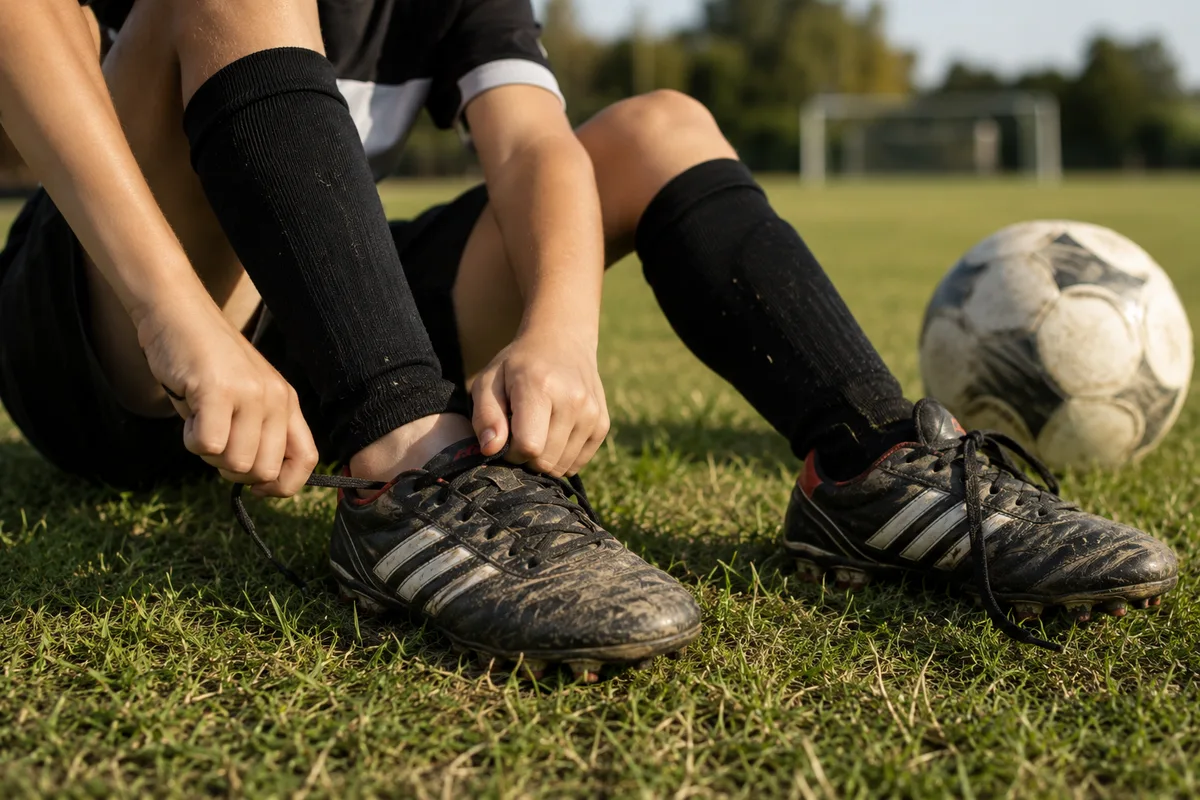
Children almost never tell you their boots are too small. They tell you their feet hurt and you put it down to football, or they say nothing at all and just stop enjoying training. Meanwhile the foot inside the boot keeps growing — and a boot that fitted in September can be a size short by the new year.
This is one of the most common and most missed problems in youth sport. It is also one of the easiest to catch, once you know what you are looking for.
How quickly the problem arrives
A young child's feet grow by roughly 15 to 18 millimetres a year. Even an older child, into the school years, adds around 8 to 12 millimetres a year. That is most of a shoe size annually, and it does not arrive smoothly — it comes in bursts, often without warning, which is why boots can feel fine for months and then suddenly become a problem within weeks.
Parents are not bad at this through carelessness; the feet simply move quickly. Study after study finds the same thing: a large share of children are walking around in shoes that are already too short. One community study of 858 children found 88.8% were wearing indoor shoes of insufficient length, and 69.4% were in outdoor shoes that were too short. Other surveys across Europe and the UK put the figure anywhere from a third to two-thirds. The point is not the exact number. It is that a child in shoes that are too small is the normal case, not the exception — so it is worth checking on purpose rather than assuming.
Why a tight boot matters more than a tight trainer
Football boots are already a close, performance fit. They are meant to sit snug so the foot does not slide when a child turns, stops and sprints. They are also thin and stiff compared with a cushioned trainer. So when a boot is genuinely too small, there is no give to take up the slack — the toes are simply jammed against a firm front, on every stride, several times a week.
Over time, that pressure does not just hurt. The same study of children's feet found a clear, statistically significant link: the shorter the shoe, the greater the sideways deviation of the big toe. Short footwear in childhood is a recognised risk factor for hallux valgus — the bunion-type angle where the big toe drifts towards the others. To be fair, footwear is not the only cause of that, and one cramped season will not deform a foot. But the developing foot is soft and adaptable in a way an adult foot is not, and a boot that is consistently too short is pushing it in the wrong direction for no good reason.
The signs to look for
You will usually spot a too-small boot from the foot, not the boot.
The toenails. Bruised or blackened toenails — especially on the big toe or second toe — are a classic sign. They come from the toe ramming the front of the boot repeatedly, bleeding under the nail. If you see a darkening nail and your child plays in boots, suspect the fit before anything else.
Red marks and blisters. Pressure marks across the tops of the toes, or at the very end of them, point to a boot that is too short. Blisters at the front of the foot or on the toes often come from the same place — when there is no room, the foot shears against the boot with every change of direction.
The toe-curl, and the reluctance. Watch a child take their boots off. Toes that have been curled under, or red lines pressed across them, tell you they have been folding to fit. A child who quietly stops wanting to put their boots on, or peels them off the moment training ends, is often telling you they are uncomfortable without having the words for it.
A limp or a niggle that clears with rest. Forefoot pain that flares during football and settles afterwards can have several causes, but a boot that is too small is a cheap and common one to rule out first.
One thing that is not a too-small sign: heel slip and the foot sliding around. That is the opposite problem — a boot that is too big — and it causes its own blisters and instability. Both matter. Boots that are too large are not a safe default just because they buy time.
The two-minute check
You do not need a shop or a gadget.
With the boot on, fully laced, and your child standing with their weight on it, press your thumb down at the very end of the boot. You are feeling for the longest toe. There should be roughly a thumb's width — about 5 to 7 millimetres — of space in front of it. Less than that and the boot is too short.
Better still, take the insole out, put it on the floor, and have your child stand on it barefoot. You can see immediately whether the toes reach or overhang the front, and you will often spot the toe imprint worn into the very front edge of an outgrown insole. Do this for both feet — most children have one foot slightly larger than the other, and you fit to the bigger one. (If you want to do it properly with a ruler, here is how to measure your child's feet at home.)
The Dubai detail: heat, swelling, and a year-round season
Feet swell during and after exercise, and they swell more in heat — by up to roughly half a size as the day goes on. A boot tried on in an air-conditioned room first thing in the morning will feel more generous than the same boot on a warm pitch at 5pm with a session's worth of blood in the foot. That is exactly when the fit matters.
So measure and fit in the evening, with the football socks your child actually plays in (they are thicker than school socks and change the fit). And remember that here, the football calendar runs much of the year — academy and school football rarely stops for long, and hard, hot pitches and 3G surfaces load the front of the foot on every stop and turn. Boots get heavy use and feet keep growing through it. A sensible habit is to re-check the fit at the start of each term and any time your child mentions discomfort. Last season's size is not a safe assumption.
What good fit feels like
A boot that fits is snug across the midfoot — a firm, secure hold with no sliding — and has that thumb's width at the very end. It should feel close, not tight. Resist the urge to size up to "get a season out of them": a boot bought two sizes big to last causes slipping, blisters and the heel instability that can feed heel pain, and it usually still needs replacing before the foot grows into it.
Checking takes two minutes and costs nothing. If you are ever unsure, a quick measure settles it — and it is a great deal cheaper than a season of sore feet and a put-off footballer.
Sources
- Klein C, Groll-Knapp E, Kundi M & Kinz W (2009). Increased hallux angle in children and its association with insufficient length of footwear: a community-based cross-sectional study. BMC Musculoskeletal Disorders, 10:159. (858 children)
- Study of Andalusian schoolchildren (2021) linking short footwear to hallux valgus development.
- Paediatric foot-growth data and footwear-fitting guidance — American Academy of Pediatrics; clinical fitting guides.