A quick note: KISH stocks shoes from some of the brands in this article. We've written it the way we write everything in the Lab — to be useful to you, whatever you end up buying and wherever you buy it.
HYROX launched in Hamburg in 2017 and has become one of the fastest-growing sports in the world — PUMA, its footwear partner, expects more than 1.3 million participants across 85-plus cities by the end of this season. It has also handed the shoe industry a genuinely new design problem: a race that is half running, half gym. In the past twelve months PUMA released what it calls the first shoe purpose-built for the sport, adidas followed with a dedicated hybrid racer, On launched its first, and Nike has announced two.
So the fair questions are the ones behind the title. Do you actually need one — and if you buy one, what are you getting?
What HYROX asks of your body
The format never changes, which is half its appeal. You run one kilometre, then complete a station, eight times over: a 1,000m SkiErg, a 50m sled push, a 50m sled pull, 80m of burpee broad jumps, a 1,000m row, a 200m farmers carry, 100m of sandbag lunges, and 100 wall balls. Eight kilometres of running in total — and seven of those eight start on legs that have just done something heavy. The weights change by division; the order doesn't, which is why a time in Abu Dhabi means the same as a time in Stockholm.
The research on HYROX is young, and worth reading with that in mind. In the most-cited physiology study so far — a simulated race with 11 recreational athletes, published in Frontiers in Physiology in 2025 — heart rate peaked at 185 beats a minute and blood lactate at 8.5 mmol/L, with the stations driving the higher readings rather than the runs. But the finding that matters most here is the other one: running capacity was the strongest predictor of overall time. The stations are what hurt. The running is what decides.
The injury picture points the same way. A 12-week prospective study of HYROX athletes published this year found that in any given week around 30% were carrying some kind of health problem. Nearly three-quarters of injuries were overuse rather than acute, the knee was the most commonly injured area, and where a cause was recorded, running accounted for 43% — more than the stations (30%) or strength training (27%). A separate international survey, still a preprint awaiting peer review, found almost half of HYROX athletes had picked up at least one injury in the previous year, and that the one factor predicting it was simply how often they trained.
So before we get to shoes: the biggest lever on both your finishing time and your injury risk is how you run, and how much. Which rather frames the footwear question.
What each part of the race asks of a shoe
A HYROX shoe is being asked to do four jobs that pull in different directions:
- Run efficiently for 8km — cushioning, energy return, a rocker. The things a road racing shoe does well.
- Grip on the sled carpet. At races the sleds run on a thin carpet taped over the concrete venue floor, and it is slower and slippier than the gym turf most people train on. The push happens from midfoot to toe, so that is where you want real rubber.
- Flex for lunges and burpees. Every lunge bends your back foot at the toes, and burpee broad jumps bend and scuff the forefoot.
- Stay stable under load — lunging with a sandbag, catching a wall ball, carrying heavy kettlebells. Tall, soft, narrow platforms wobble.
The trouble is that the first job fights the last two. The tall, soft foam stacks that make a road super shoe fast can make it feel unsteady under a sandbag, and a stiff carbon plate resists the bend your foot makes in every lunge. HYROX's rules ask for little more than closed-toe shoes, so this is purely a design trade-off, not a rulebook one — and it's the trade-off the purpose-built HYROX shoes were created to solve. HYROX's own advice for the sled is refreshingly short: "invest in some grippy shoes!"
The shoes built for HYROX
These are the purpose-built HYROX and hybrid shoes from the biggest brands, on sale or announced as of late September 2026:
- PUMA x HYROX Deviate NITRO Elite 4 — PUMA's purpose-built HYROX racer, on sale since February 2026 at around US$260 / £210, re-engineered for the race with an all-new full-coverage PUMAGRIP outsole and a new carbon plate.
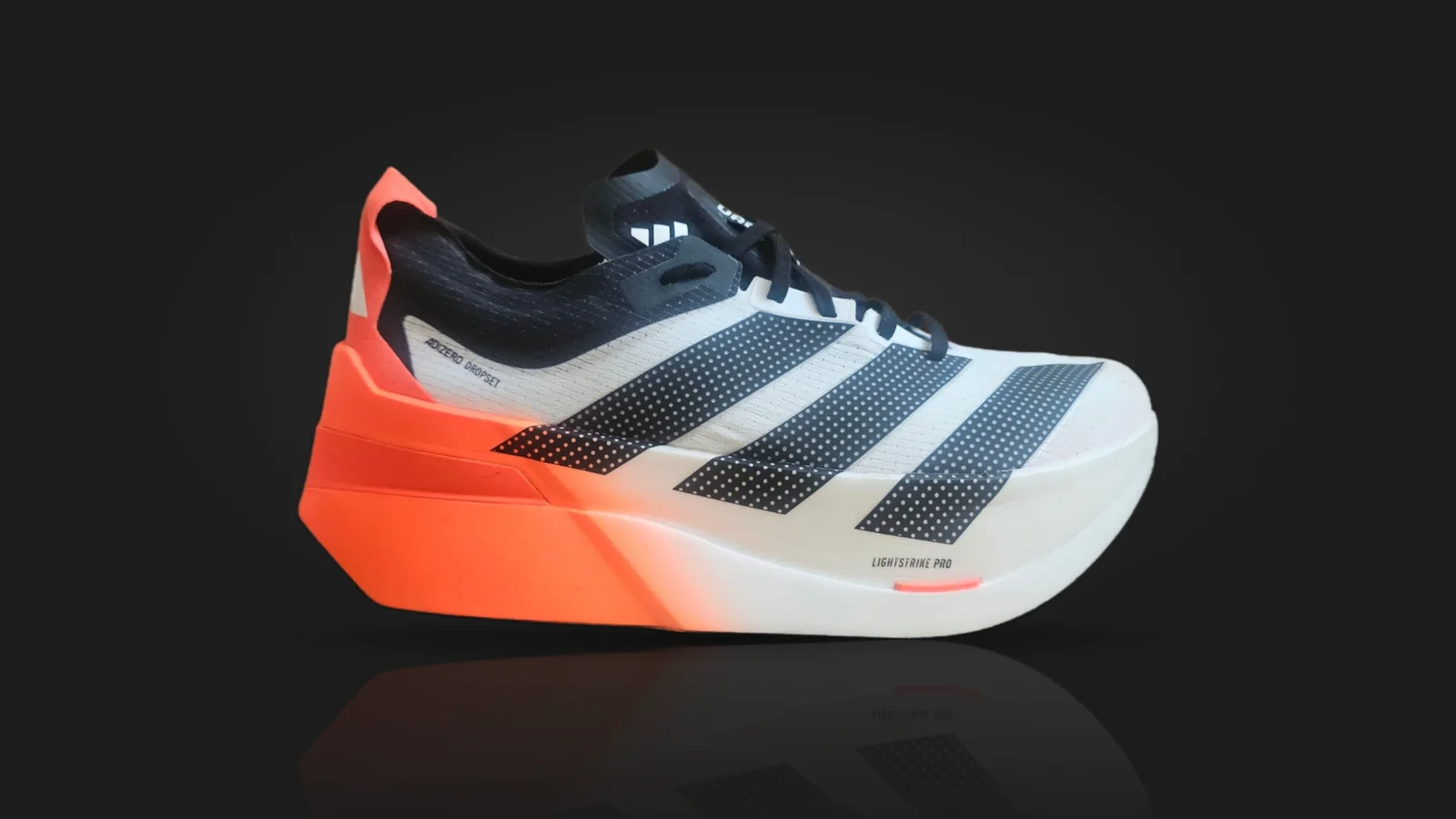
- adidas Adizero Dropset Elite and Dropset Pro — adidas's first HYROX racer (on sale in Europe from March 2026) pairs Lightstrike Pro foam with a carbon-infused "Energy Rim" around the heel instead of rods or a plate, Continental rubber, and a steep 12mm drop that adidas says sets you up for wall balls and lunges. The Dropset Pro (June 2026) is its lower-built training partner.
- On Cloud X Tempo Pro — On's first hybrid racer (August 2026), co-developed with Alexander Rončević, who held the HYROX world record when it launched: a carbon plate, a reinforced midfoot cage and an integrated strap, though at around 309g it's heavy for a racer.
- Nike Hybrid RN and Hybrid Fly — a plateless hybrid trainer on sale from 8 October 2026, and a carbon racer due in 2027, which Nike says 2026 men's world champion Dylan Scott won his title in as a prototype.
Not every shoe with HYROX on it was built for the race. PUMA's earlier HYROX editions of the Deviate NITRO 3 and Deviate NITRO Elite 3 are, in PUMA's own words, unique colourways of existing shoes — capable ones, as our grades show, but the standard shoes underneath.
What the purpose-built shoes share is the aim, and it's to their credit. Each takes technology from fast road shoes and reworks the parts that let road shoes down in HYROX: according to their makers, stickier rubber for the sled carpet, a steadier platform and more lockdown for lateral work. That's real engineering aimed at a real problem, and many of the sport's best athletes race in them — though most are sponsored by the brands that make them.
What the lab data says
We haven't found independent lab data for the purpose-built racers yet, but labs have tested plenty of the road shoes people race HYROX in. So we graded nine shoes station by station — seven on independent lab measurements, and adidas's two Dropsets provisionally until they've been tested. The headline is the trade-off in action: no shoe earned top marks at every station. The liveliest foams win the runs and the grippiest rubber wins the sled, but every carbon-plated shoe we graded loses marks at the lunges, because a stiff plate doesn't want to bend. The full grades, the method and the numbers are in HYROX shoes graded: nine shoes, station by station.
So, do you need one?
You don't need one. RunRepeat's own guide to the best HYROX shoes names seven, and none is a purpose-built HYROX racer (though RunRepeat hasn't lab-tested those yet) — the grip, stability and running efficiency HYROX needs can be found in shoes that weren't built to race it. We haven't found an independent head-to-head between the purpose-built shoes and the best general ones. So it comes down to how you race.
For your first or second HYROX, or on a budget: a well-fitted shoe you already run well in, with rubber that runs right to the toe and a platform that doesn't wobble when you lunge. In our grades, look for two or three dots in every column rather than three in one and one elsewhere. Running capacity was the strongest predictor of finishing time in the physiology research, so a shoe you run well in is the right starting point.
If you want one shoe that simply does the job: this is where a dedicated shoe earns its place at any level, not just at the front of the field. Finding a regular shoe that runs well, grips on the sled carpet and stays steady under a sandbag takes some trial and error. A HYROX shoe is that combination already worked out — designed around the race and refined by the athletes who do it most. That's a perfectly good reason to buy one.
If you're chasing a time, an age-group place or a podium: a carbon-plated racer makes its strongest case — in our grades, both carbon-plated racers — PUMA's Deviate NITRO Elite 3 and Saucony's Endorphin Pro 5 — score top marks on the runs and on the sled, at a cost at the lunges. As with any carbon racer, save it for race day — the foam wears quickly, and our guide to how long running shoes last puts carbon racers at roughly 240–400km — and train in something else. That's exactly the gap hybrid trainers such as Nike's Hybrid RN and adidas's Dropset Pro are aimed at.
What to avoid, whatever your level: a tall, narrow road super shoe with a very stiff plate (unsteady under load, and hard work in lunges); a flat, rigid lifting or cross-training shoe (fine for wall balls, punishing across 8km of running); and anything with patchy outsole rubber, which the sled carpet exposes immediately.
And test it on a sled before race day. If your feet slide during a push in the gym, they'll slide more on the race carpet.
The Dubai dimension
HYROX only arrived in the UAE in 2025, and it has landed hard. The first Abu Dhabi race drew 3,506 athletes from 124 nationalities, including 340 Emiratis; 41% were women, and the biggest age group was 30–35 — which is to say, a lot of parents. There has even been a HYROX-style simulation run inside Ski Dubai at –4°C.
Two local points for your shoes. The races are indoors, so heat isn't the race-day problem — but much of the training happens outdoors, and a carbon racer left in a hot car or drying in direct sun loses foam life fast, as we've covered before. Store them somewhere cool.
And for younger athletes
Adult HYROX races are open from age 16. For younger children there is HYROX Youngstars, for 8-to-15-year-olds, which keeps the eight-station format but scales the weights and the running right down — under-12s run somewhere around 600 to 825 metres in total, rather than eight kilometres.
Our advice for those children is the same as everywhere else in the Lab: an ordinary, well-fitting trainer with good grip. Not a carbon racer — we've set out why plated shoes don't suit growing feet in our piece on super shoes — and not an adult shoe bought to grow into. For teenagers racing the adult format, the injury research above deserves attention: how often people trained was the one thing that predicted injury, which is exactly the load question we tackle in how much running is too much.
The bottom line
HYROX is a running race with a gym in the middle of it. The research so far says running is the biggest single factor in your finishing time and the most common cause of injury. When we graded nine shoes, none was best at everything: the liveliest foams win the runs, the grippiest rubber wins the sled, and every carbon-plated shoe we graded costs you something at the lunges. You don't need a dedicated HYROX shoe to race well. The purpose-built ones are designed around exactly this trade-off, which is a good reason to try them — though until they've been through a lab, there's no independent measure of how well each one solves it. Whatever you choose, pick the shoe whose trade-off suits the way you race, and make sure it fits.
Sources: HYROX official format, race guidance ("invest in some grippy shoes!") and rulebook (age minimum 16); HYROX Youngstars format (ages 8–15) · "Acute physiological responses and performance determinants in Hyrox©", Frontiers in Physiology (2025) · "Prevalence, burden and risk markers of health problems in HYROX athletes: a 12-week prospective cohort study", Frontiers in Sports and Active Living (2026) · "Injury epidemiology in HYROX athletes: an international cross-sectional survey", medRxiv (2026, preprint — not yet peer-reviewed) · RunRepeat, "Best HYROX shoes 2026" — independent lab testing, self-purchased shoes · PUMA newsroom and Media Hub (HYROX collection, January 2025; Deviate NITRO Elite HYROX launch, December 2025) · adidas, On and Nike product announcements and specifications (manufacturer claims where quoted) · Independent reviews: Canadian Running, Men's Journal, Women's Running, Road Trail Run · Abu Dhabi Sports Council, HYROX Abu Dhabi 2025 participation figures. See also The Lab: "HYROX shoes graded: nine shoes, station by station", "How many miles before you retire your running shoes", "Are super shoes good for children?", "How much running is too much for children", and "The nerdy guide to running shoe foam".
KISH stocks shoes from some of the brands mentioned in this article. Specifications and prices are as published by manufacturers and reviewers in September 2026, and change quickly.