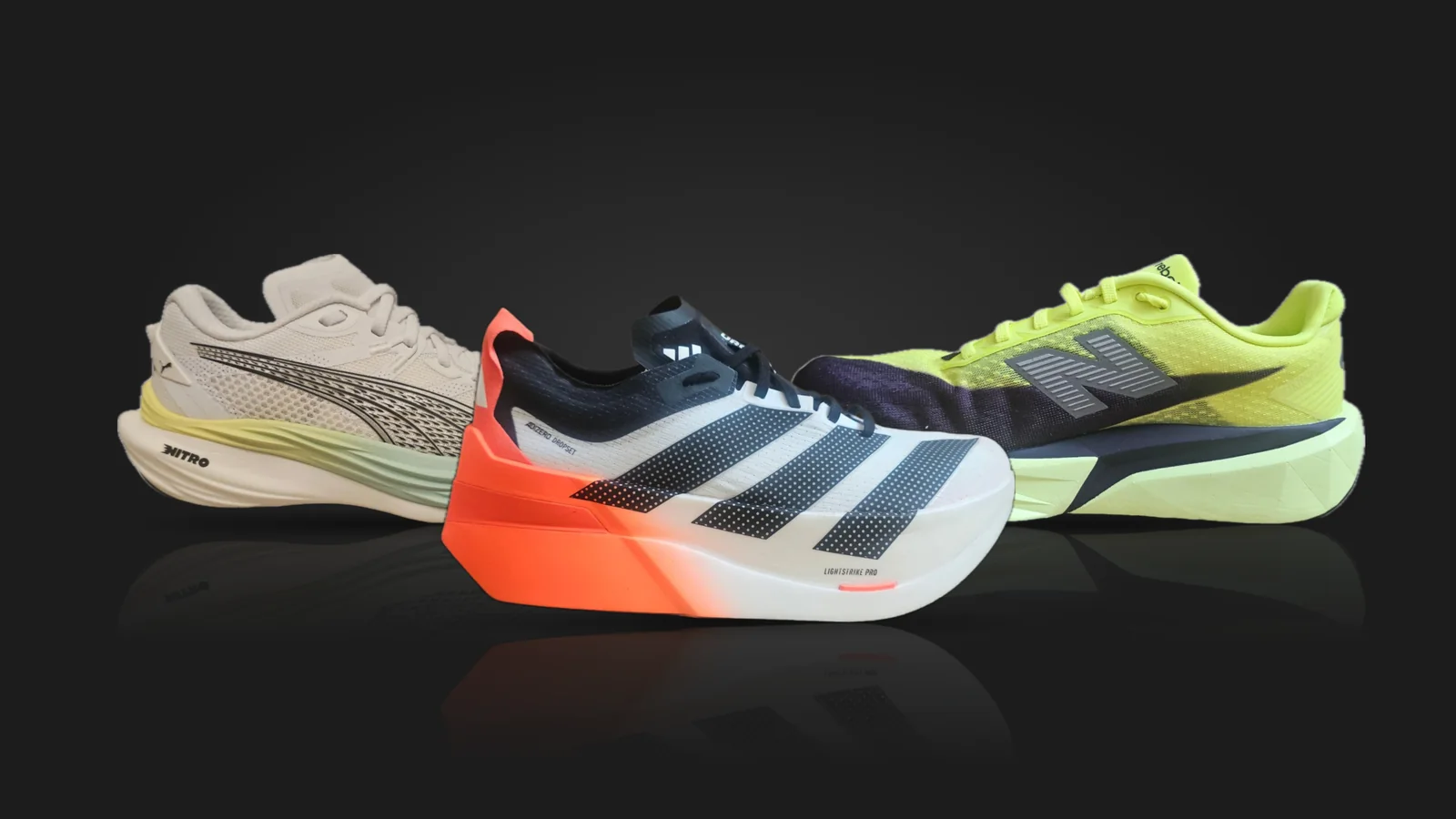
A quick note: KISH stocks shoes like these, from every brand in the table. That's why seven of the nine are graded by a fixed rule on independent lab measurements rather than our opinion, why the two that haven't been lab-tested yet are clearly marked as provisional, and why every shoe gets a trade-off as well as a strength.
A HYROX shoe has four jobs that pull in different directions: run efficiently for 8km, grip on the sled carpet, bend for lunges and burpees, and stay steady under a sandbag or a pair of heavy kettlebells. We set out why — and whether you need a dedicated HYROX shoe at all — in Do you really need a HYROX shoe? This piece answers the next question: which shoe is good at what?
We graded nine shoes against each part of the race: two HYROX editions from PUMA, adidas's two hybrid shoes, and five road shoes that plenty of athletes race in.
How we graded them
Every grade for the seven lab-tested shoes comes from one independent lab, RunRepeat, which buys every shoe it tests, doesn't accept sponsorship for its lab tests, and measures hundreds of pairs the same way. For each part of the race we took the measurement that best matches what it asks of a shoe, and compared each shoe with the lab's average across several hundred running shoes. More than 10% better than average earns three dots; within 10% either side, two; more than 10% worse, one.
- Running: energy return at the heel — how much of the energy you put into the foam comes back to you.
- Sled push and pull: forefoot grip, measured with a standard slip-test rig on wet concrete. It isn't race carpet, but it's the only standardised grip measurement available for all seven shoes.
- Lunges and burpee broad jumps: how much force it takes to bend the forefoot. Every lunge bends your back foot at the toes, and a stiff plate fights it.
- Carries and wall balls: how tall the shoe stands compared with how wide its base is — our own simple calculation from the lab's measurements, and the same reason a tall, narrow bookcase wobbles more than a low, wide one. A shoe loses a dot if its foam is more than 10% softer than average, because soft foam squashes and shifts under a heavy load.
We haven't graded the SkiErg or the row: on the rower your feet are strapped in, and the SkiErg asks little of a shoe beyond a steady stance.
The grades
●●● more than 10% better than the lab average · ●● within 10% either side · ● more than 10% worse
| Shoe | Running | Sled push & pull |
Lunges & burpees |
Carries & wall balls |
|---|---|---|---|---|
| PUMA x HYROX Deviate NITRO 3 |
●● | ●●● | ● | ● |
| PUMA x HYROX Deviate NITRO Elite 3 |
●●● | ●●● | ● | ● |
| Nike Zoom Fly 6 |
●● | ● | ● | ● |
| Saucony Endorphin Pro 5 |
●●● | ●●● | ● | ●● |
| Saucony Endorphin Speed 5 |
●●● | ●● | ●●● | ●● |
| New Balance FuelCell Rebel v5 |
●● | ●● | ●●● | ● |
| HOKA Mach 6 |
●●● | ●● | ●●● | ●● |
| adidas Adizero Dropset Pro † |
●● | ●●● | ●● | ●●● |
| adidas Adizero Dropset Elite † |
●● | ●● | ●● | ●● |
† Not yet lab-tested, so these grades are provisional — based on adidas's published specifications and reviewers' reports. We start at two dots and move a grade only where the specification and more than one independent reviewer agree. We'll update them when lab data is published.
Two caveats. Treat the dots as bands, not verdicts: a shoe just over a line has more in common with one just under it than with the ends of the scale. And none of this outranks fit — the best-graded shoe in the table is the wrong shoe if it doesn't suit your foot.
The pattern worth noticing: no shoe earns three dots everywhere. The liveliest foams win the runs, and the grippiest rubber — on the two PUMAs and the Endorphin Pro 5 (and, provisionally, the Dropset Pro) — wins the sled. But every carbon-plated shoe in the table scores one dot for lunges and burpees, because a stiff plate doesn't want to bend; the bendier trainers win there instead. And the only shoe to earn three dots for carries and wall balls is the lowest-built one, adidas's hybrid trainer, the Dropset Pro — provisionally, until it's been through a lab. Choosing a HYROX shoe is choosing which trade-off suits you.
Shoe by shoe
PUMA x HYROX Deviate NITRO 3. PUMA's carbon-plated everyday trainer in HYROX colours. PUMA describes its HYROX editions as unique colourways of existing shoes, so the standard shoe's lab results apply. Strength: grip. It carries more of PUMA's PUMAGRIP rubber than the Elite, scored 0.65 against a lab average of 0.53, and testers who've raced HYROX in it say the sled is exactly where it shines. Trade-off: a stiff forefoot and a heel 9% narrower than average cost it at the lunges and the loaded stations — though those same testers found it steady enough — and at 268g it's the heaviest of the seven lab-tested shoes.
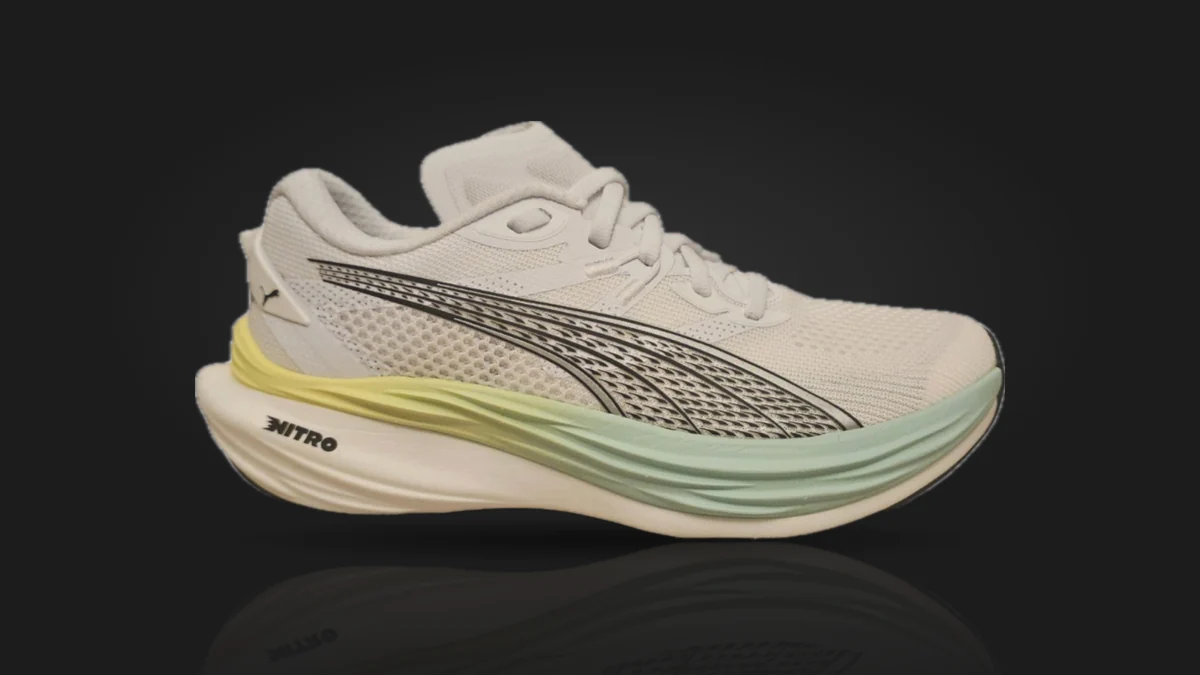
The standard PUMA Deviate NITRO 3. PUMA's HYROX edition is the same shoe in HYROX colours. Photo: KISH.
PUMA x HYROX Deviate NITRO Elite 3. PUMA's marathon racer in HYROX colours — again, the standard shoe underneath. Strength: 77.1% energy return, the highest of the seven lab-tested shoes, at just 204g, with grip to match (0.67). Trade-off: a stiff carbon plate that makes lunges hard work, and of the seven lab-tested shoes it stands tallest for its width; testers split on how planted it feels under a sandbag. Most rate its sled grip, though one reported slipping on race carpet. PUMA has since followed it with a purpose-built HYROX version (see "Not graded yet", below).
Nike Zoom Fly 6. A carbon-plated "super trainer" that RunRepeat rates highly as a running shoe and finds notably durable. Strength: your running sessions in training. Trade-off: for HYROX, its station numbers all point one way — the lowest grip of the seven (0.42), the second-stiffest forefoot, and a tall, narrowish platform. We found no one who has tested it on a sled.
Saucony Endorphin Pro 5. RunRepeat's best overall shoe for HYROX, and the lab shows why. Strength: excellent energy return (72.8%), the best grip of the seven (0.68), and a broader base than most carbon racers. Trade-off: by far the stiffest forefoot here — 26.1N against an average of 15.5N — which RunRepeat itself says makes lunges more work.
Saucony Endorphin Speed 5. A nylon-plated trainer that bends where carbon won't. Strength: 73.2% energy return — RunRepeat's energy-return pick for HYROX — and one of the most flexible forefoots here, so lunges and burpees come easily. Trade-off: grip is only average (0.52), and the midfoot is bare foam, so on the sled the forefoot rubber does all the work. With the Mach 6, it's one of only two lab-tested shoes without a one-dot grade.
New Balance FuelCell Rebel v5. Light (220g), low and plateless. Strength: the most flexible forefoot of the seven lab-tested shoes, so it bends most easily in lunges and burpee broad jumps. Trade-off: by far the softest foam here, and it twists easily. Two wear-test reviews found it unsteady side to side, though two labs rated its stability well; under a sandbag or heavy kettlebells, soft foam is still a risk. Grip is exactly average.
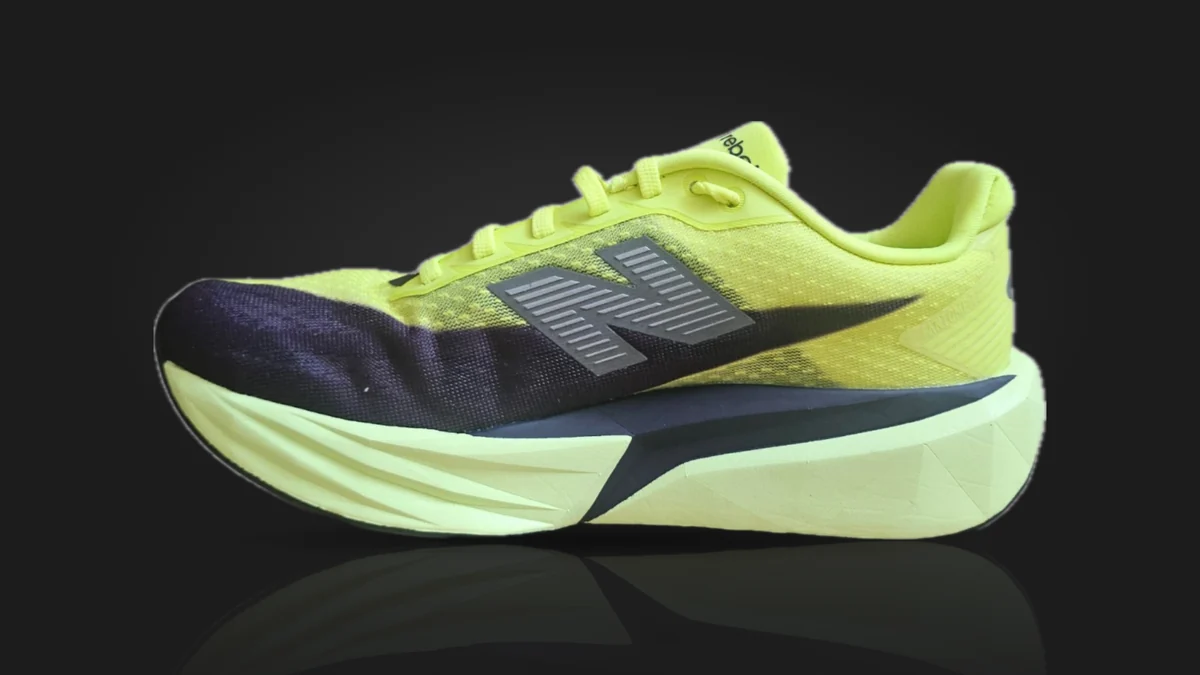
The New Balance FuelCell Rebel v5. Photo: KISH.
HOKA Mach 6. The quiet all-rounder. Strength: lively foam (65.4%), a flexible forefoot, and one of the steadier platforms among the road shoes. Trade-off: grip is a little below average (0.49), and lower than the previous version's. Worth knowing: HOKA has now replaced it with the Mach 7, RunRepeat's pick for grip in its HYROX guide. They're different shoes, so don't assume the Mach 7's grip applies to the Mach 6.
adidas Adizero Dropset Pro †. adidas's hybrid training shoe, launched in June 2026: Lightstrike Pro foam with Energyrods, Continental rubber, a protective toe cap and a low 29mm heel. Strength: the stations. Reviewers consistently praise its grip, and testers felt the low, wide platform in weighted lunges and carries. Trade-off: testers found it firm and stiff for longer, easier runs. The natural training partner to a race-day shoe.
adidas Adizero Dropset Elite †. adidas's first HYROX racer, on sale in Europe from March 2026: Lightstrike Pro (the foam in its marathon racers), a carbon-infused "Energy Rim" around the heel instead of rods or a plate, Continental rubber, and a steep 12mm drop that adidas says sets you up for wall balls and lunges. Strength: on paper, race-day running — adidas's racing foam at a claimed 210g or so. Trade-off: adidas states a 44mm heel, the tallest in the table, and the only independent test we found took place at an adidas-hosted event. The tester liked its grip, lockdown and ride across that short event (running, sled push, wall balls, burpees and lunges), but one test isn't enough to move a grade, so all four stay at two dots for now.
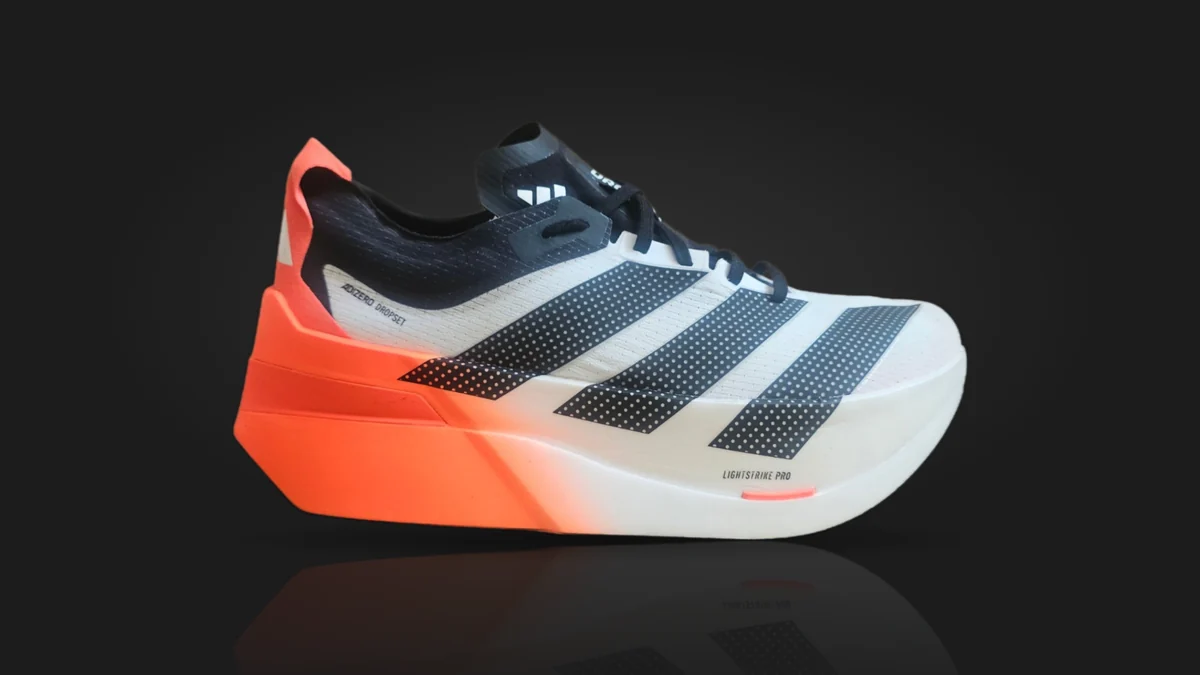
The adidas Adizero Dropset Elite. Photo: KISH.
The numbers behind the dots
| Shoe | Energy return (heel) |
Forefoot grip |
Force to bend |
Height- to-width |
Foam firmness |
Weight |
|---|---|---|---|---|---|---|
| Lab average | 58.7% | 0.53 | 15.5N | 0.304 | 35.4 | 261g |
| PUMA x HYROX Deviate NITRO 3 |
60.7% | 0.65 | 20.6N | 0.337 | 37.7 | 268g |
| PUMA x HYROX Deviate NITRO Elite 3 |
77.1% | 0.67 | 18.1N | 0.356 | 35.5 | 204g |
| Nike Zoom Fly 6 |
61.0% | 0.42 | 21.5N | 0.349 | 36.5 | 248g |
| Saucony Endorphin Pro 5 |
72.8% | 0.68 | 26.1N | 0.304 | 33.3 | 215g |
| Saucony Endorphin Speed 5 |
73.2% | 0.52 | 12.9N | 0.301 | 44.5 | 241g |
| New Balance FuelCell Rebel v5 |
59.8% | 0.53 | 11.7N | 0.289 | 25.9 | 220g |
| HOKA Mach 6 |
65.4% | 0.49 | 13.7N | 0.301 | 39.5 | 232g |
RunRepeat lab measurements, as published in September 2026; the two PUMA HYROX editions share the standard shoes' construction. Lower force to bend means a more flexible forefoot. Height-to-width is our calculation — average stack height divided by average midsole width, across heel and forefoot — and lower suggests a steadier platform. Foam firmness is a durometer reading: higher is firmer.
How to use the grades
For your first HYROX, or on a budget: look for two or three dots in every column rather than three in one and one elsewhere — and start from a shoe you already run well in, because the research so far says running is the biggest single factor in your finishing time.
If you're chasing a time: the two carbon-plated racers, PUMA's Deviate NITRO Elite 3 and Saucony's Endorphin Pro 5, score three dots on the runs and on the sled, at a cost at the lunges. Save a carbon racer for race day — the foam wears quickly, and our guide to how long running shoes last puts carbon racers at roughly 240–400km — and train in something that bends more easily.
Whatever you choose: test it on a sled before race day. If your feet slide during a push in the gym, they'll slide more on the race carpet.
Not graded yet
PUMA's purpose-built Deviate NITRO Elite 4 HYROX, On's Cloud X Tempo Pro and Nike's Hybrid RN and Hybrid Fly aren't in the table, because we haven't found independent lab data for them yet or they aren't on sale. What they are, and what they're designed to do, is in Do you really need a HYROX shoe? We'll update the grades as lab results are published.
Sources: RunRepeat independent lab reviews (self-purchased shoes) of the PUMA Deviate Nitro 3 and Deviate Nitro Elite 3, Nike Zoom Fly 6, Saucony Endorphin Pro 5 and Endorphin Speed 5, New Balance FuelCell Rebel v5 and HOKA Mach 6, and RunRepeat, "Best HYROX shoes 2026" · PUMA newsroom (HYROX collection, January and June 2025) and product pages · adidas product pages and specifications (manufacturer claims where quoted) · Independent reviews: Women's Running, Road Trail Run, Doctors of Running, Tom's Guide, Men's Journal, Man of Many, Outdoor Gear Lab, RTINGS · "Acute physiological responses and performance determinants in Hyrox©", Frontiers in Physiology (2025). See also The Lab: "Do you really need a HYROX shoe?", "How many miles before you retire your running shoes" and "The nerdy guide to running shoe foam".
KISH stocks shoes like these, from every brand graded in this article, and may stock others mentioned in it. Grades for the seven lab-tested shoes use RunRepeat's published lab measurements as of September 2026 and the method set out above; the two adidas grades (†) are provisional. Specifications and prices change quickly.