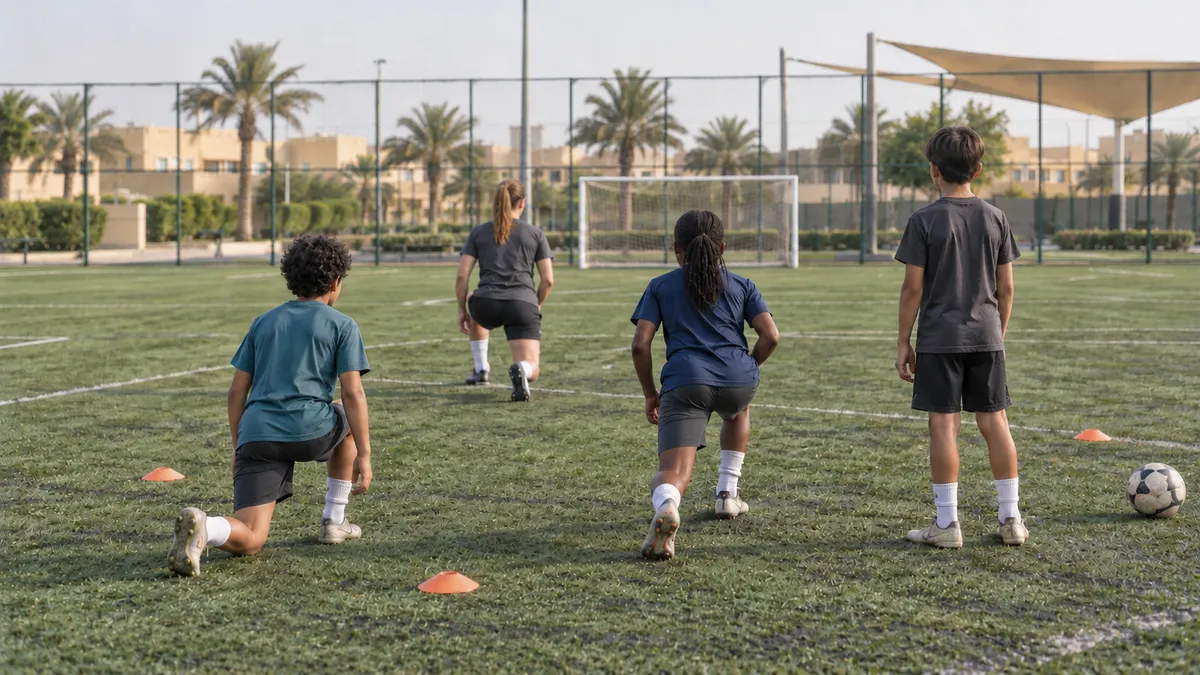
Ask parents on a Dubai touchline whether a ten-year-old should do strength training and the same worry comes up: won't it stunt their growth, or damage their growth plates? It's one of the longest-running concerns in youth sport, and the research doesn't support it.
Supervised, well-designed strength training is safe for school-age children and makes them measurably stronger, and short warm-up programmes that include strength work cut injuries in young footballers. There's no evidence it stunts growth. The word that matters is supervised: most reported injuries happened without proper supervision, with too much weight, or on equipment at home.
By strength training we mean any exercise that makes muscles work against resistance: body weight, resistance bands, medicine balls, machines or free weights.
Where the worry comes from
For decades, children were steered away from weights. Experts believed they couldn't get stronger before puberty, and there were fears about injury and growth plates. The growth-plate fear has a real origin: in the 1970s and 1980s, doctors reported a small number of growth-plate fractures, mostly in teenagers lifting heavy weights overhead. Looking back at those reports, the US National Strength and Conditioning Association (NSCA) concluded that most "were due to improper lifting techniques, maximal lifts, or lack of qualified adult supervision", and that injury to the growth cartilage "has not been reported in any prospective youth resistance training research study."
What the research says about growth
The most thorough look is a 2006 review by Robert Malina, a leading researcher on child growth, of 22 training studies in children before or early in puberty, aged roughly 5 to 14. Nine measured height before and after, and the children who trained grew as much as those who didn't. In the longest, boys of about nine trained for 21 months. They grew 3.6cm in the first year against 4.1cm for the boys who didn't train, and 6.1cm against 5.2cm in the second.
The 2014 international consensus statement on youth strength training, endorsed by the American Academy of Pediatrics (AAP), the NSCA and the UK's Faculty of Sport and Exercise Medicine among others, puts it plainly: "no scientific evidence indicates that resistance training will have an adverse effect on linear growth during childhood or adolescence or reduce eventual height in adulthood."
There are limits. The growth studies were small and mostly a few months long, nobody has followed strength-trained children to adult height, and teenagers in the middle of their growth spurt are among the least studied. So the honest claim is that there's no sign of harm, not that harm has been ruled out for every age and every programme. For scale, the same statement notes that ordinary jumping and landing can produce forces of about five to seven times body weight, more than strength training produces.
Where injuries happen
The NSCA's reading of the injury reports is consistent: poor technique, too much weight, badly designed equipment, easy access to equipment, or no qualified adult supervising, with exercise equipment at home a particular risk. In US emergency-department records, about two-thirds of weight-training injuries in children aged 8 to 13 were to the hands and feet, most often from weights being dropped or body parts pinched.
Ordinary jumping and landing can produce forces of about five to seven times body weight, more than strength training produces.
— The 2014 international consensus on youth strength training
Supervised training looks very different. Across the ten studies in Malina's review that tracked injuries, there were three: two shoulder strains and thigh pain from a falling bar. None was to a growth plate.
What children gain
Strength, by a lot. A 2010 analysis of 42 studies, covering 1,728 children and teenagers, found that those who trained gained far more strength than those who didn't, with longer programmes and more sessions a week bringing bigger gains. In one small study, children aged 7 to 12 who trained twice a week for eight weeks improved their leg strength by 53.5% and their chest-press strength by 41.1%, against 7.9% for children who didn't train. It faded again when they stopped.
Mostly through the nervous system, not bulk. Before puberty, most of the gain comes from the nervous system learning to use the muscle better. In a 20-week study of boys aged 9 to 11, bench-press strength rose by 35% with no significant change in muscle size on scans, though the NSCA is careful not to rule out some muscle growth.
Some carry-over to sport. A review of 43 studies of 1,558 young athletes aged 6 to 18, mostly in team sports, found the biggest gains in strength, smaller ones in jumping, sport skills and agility, and the smallest in sprinting.
In a trial of 3,895 young footballers, teams that used FIFA's 11+ Kids warm-up had about half the injury rate of teams doing their usual warm-up.
— The 11+ Kids trial, Sports Medicine (2018)
Fewer injuries, from warm-ups
The best evidence that strength work prevents injuries in young athletes comes from short warm-ups, 15 to 20 minutes at the start of training, that mix strength exercises with balance, jumping, landing and running drills.
- The 11+ Kids, FIFA's warm-up for children: in a trial of 3,895 young footballers in under-9, under-11 and under-13 teams in four European countries, teams that used it had about half the injury rate of teams doing their usual warm-up, and about a quarter of the rate of severe injuries, those that kept a child out for more than four weeks. Almost all the players were boys, and FIFA funded the study.
- The 11+, for older players: among 1,892 Norwegian girls aged 13 to 17, 13.0% of players in teams using it were injured during the season, against 19.8% in the other teams, and 4.3% had a severe injury, against 8.6%. The trial's main measure, injuries to the legs, also fell, but not by enough to rule out chance.
- Serious knee injuries in girls: in a Swedish trial of 4,564 girls aged 12 to 17, teams using a knee-control warm-up had 7 torn anterior cruciate ligaments (ACL) against 14 in the other teams. These injuries are rare, so the difference in real numbers is small.
- Rugby: in English schools, with players aged 14 to 18, the overall effect was unclear; teams that did the programme three or more times a week had far fewer match injuries, but that comparison wasn't randomised.
The programmes only work when teams keep doing them. You may also see a claim that strength training cuts sports injuries to a third. It comes from a 2014 review in which it rested on four trials, three of them in adult men or military recruits aged 17 to 30, so it isn't evidence that lifting weights protects children.
What's sensible at each age
When to start. There's no minimum age. The NSCA says a child who is ready for organised sport, "generally age 7 or 8", is ready for some type of resistance training, as long as they can follow a coach's instructions. The lead author of the AAP's 2020 report goes younger: "We know children as young as 5 can build strength with one-legged hops or frog jumps."
Younger children, roughly 7 to 11: body-weight exercises, bands, climbing, hopping, jumping and learning to land well, each movement learned with little or no weight. The US physical activity guidelines say formal weight programmes aren't usually needed at this age, but are safe if properly planned and supervised.
Teenagers: machines and free weights, with coaching. British Weight Lifting puts technique before load until 13 and judges its under-13 competitions on technique.
A beginner's programme, from the NSCA's guidance: a 5- to 10-minute dynamic warm-up; 1 to 2 sets of 10 to 15 repetitions at a light to moderate load, with about a minute's rest between sets; 2 to 3 sessions a week, never on back-to-back days; weight added in small steps, about 5 to 10%, only when technique holds; and no maximum lifts unless the child has practised them and a qualified professional is closely supervising.
Around the growth spurt. The risk of leg injuries peaks around the adolescent growth spurt, and some children go through a temporary clumsy phase while their coordination catches up, so the NSCA suggests coaches reduce the load and rebuild technique. Girls who grow quickly without a matching gain in hip and knee strength also face a higher risk of knee injury, and the NSCA's view is that starting the strength, balance and landing work in the warm-ups above early is likely to reduce the risk of an ACL injury later. Growth spurts are also behind heel pain (Sever's disease) and knee pain (Osgood-Schlatter).
How much in total. The World Health Organization says children and teenagers aged 5 to 17 should include activities that strengthen muscle and bone on at least three days a week, within an average of 60 minutes of activity a day, and play and sport count. The UAE has no guidelines of its own that we could find: the Ministry of Health and Prevention points parents to WHO's 60 minutes a day, and a 2022 report card on UAE children found that about one in five school children met it. Training load counts in the gym as it does on the pitch; the warning signs are in how much running is too much.
In Dubai
Coaching. Qualifications that signal strength-and-conditioning expertise include the NSCA's Certified Strength and Conditioning Specialist (CSCS) and accreditation from the UK Strength and Conditioning Association. REPs UAE runs a public register of fitness professionals that you can search, with a category for children's fitness instructors.
Gyms. Adult gyms often have minimum ages. When we checked in October 2026, Fitness First UAE's was 16, or over 14 with a parent's or guardian's consent letter and a parent, guardian or paid personal trainer at every visit. It also runs junior memberships for ages 5 to 15 at selected clubs.
Check-ups. The NSCA says healthy children don't usually need one before starting, but children with signs of illness or a known condition should have one; the AAP's examples include uncontrolled high blood pressure or seizures, certain heart conditions and chemotherapy.
Shoes. A flat, stable, closed-toe trainer is a sensible choice. There's no research on weightlifting shoes in children, and no evidence they need them. In one study of adults, ordinary trainers were no less stable than lifting shoes when squatting without weight; with a bar, lifting shoes were slightly more stable. Many gyms require closed-toe sports shoes anyway.
The bottom line
There's no evidence that strength training stunts growth, though no study has yet followed trained children to adult height. Supervised training makes children and teenagers markedly stronger, helps their sport by a smaller margin and, as short warm-ups, cuts injuries in young footballers. The risk lies in weights at home, no supervision and too much load too soon: body weight and good technique come first, and the weight follows the technique, never the other way round.
Sources
- Malina RM (2006), Clinical Journal of Sport Medicine 16(6):478–87 — weight training in youth: growth, maturation and safety.
- Lloyd RS et al. (2014), British Journal of Sports Medicine 48(7):498–505 — the 2014 international consensus on youth resistance training.
- Faigenbaum AD et al. (2009), Journal of Strength and Conditioning Research 23(5 Suppl):S60–79 — the NSCA's position statement on youth resistance training.
- Lloyd RS et al. (2016), Journal of Strength and Conditioning Research 30(6):1491–509 — the NSCA's position statement on long-term athletic development.
- Behm DG et al. (2008), Applied Physiology, Nutrition, and Metabolism 33(3):547–61 — the Canadian Society for Exercise Physiology's position on resistance training in children and adolescents.
- Stricker PR, Faigenbaum AD & McCambridge TM (2020), Pediatrics 145(6):e20201011 — the AAP's clinical report on resistance training for children and adolescents.
- Myer GD et al. (2009), Journal of Strength and Conditioning Research 23(7):2054–60 — youth and adult weightlifting injuries in US emergency departments.
- Behringer M et al. (2010), Pediatrics 126(5):e1199–210 — a meta-analysis of resistance training in children and adolescents.
- Faigenbaum AD et al. (1996), Journal of Strength and Conditioning Research 10(2):109–14 — strength training and detraining in children.
- Ramsay JA et al. (1990), Medicine & Science in Sports & Exercise 22(5):605–14 — strength training effects in prepubescent boys.
- Lesinski M, Prieske O & Granacher U (2016), British Journal of Sports Medicine 50(13):781–95 — resistance training and performance in youth athletes.
- Rössler R et al. (2018), Sports Medicine 48(6):1493–1504 — the multinational trial of the 11+ Kids.
- Soligard T et al. (2008), BMJ 337:a2469 — a warm-up programme for young female footballers.
- Waldén M et al. (2012), BMJ 344:e3042 — neuromuscular training and knee injuries in adolescent female footballers.
- Hislop MD et al. (2017), British Journal of Sports Medicine 51(15):1140–1146 — an injury prevention programme in English schoolboy rugby.
- Lauersen JB, Bertelsen DM & Andersen LB (2014), British Journal of Sports Medicine 48(11):871–7 — exercise interventions to prevent sports injuries.
- British Weight Lifting, youth position statement (Kite, Lloyd & Hamill, 2018).
- World Health Organization, Guidelines on Physical Activity and Sedentary Behaviour (2020); US Physical Activity Guidelines for Americans, 2nd edition (2018).
- UAE Ministry of Health and Prevention, physical activity for children; Alrahma AM et al. (2023), Journal of Exercise Science & Fitness 21(2):218–225 — the UAE's 2022 report card on physical activity for children and adolescents.
- Legg HS et al. (2017), Journal of Sports Sciences 35(5):508–515 — weightlifting shoes and the squat.
- Sato K et al. (2012), Journal of Strength and Conditioning Research 26(1):28–33 — weightlifting shoes and the back squat.
- REPs UAE; Fitness First UAE club rules and junior memberships, checked 26 October 2026; NSCA and UKSCA qualification pages.