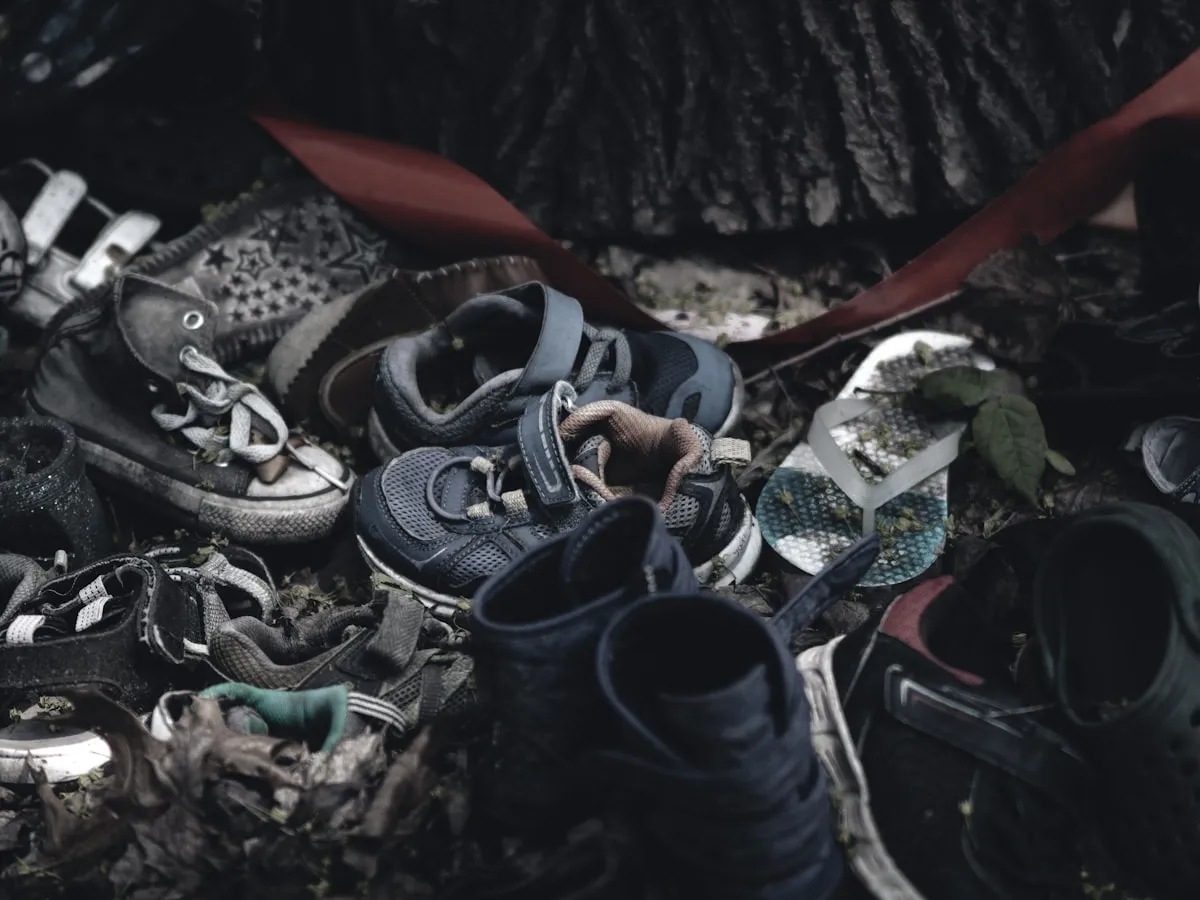
Here is a number worth sitting with: 22 billion pairs of shoes are discarded globally every single year. That figure comes from the World Footwear Association, which tracks production across the industry. It works out to roughly three pairs per person on the planet, thrown away in the time it takes the Earth to make one trip around the sun.
Most of them go straight into the ground.
The landfill problem is measured in centuries
When a pair of football boots ends up in landfill — and according to multiple industry estimates, around 95% of discarded footwear does — it doesn't quietly disappear. The rubber sole, the EVA foam midsole, the synthetic upper, the polyester lining: these are petroleum-derived materials engineered to be durable. That durability is precisely the problem. Depending on the composition, a typical synthetic sports shoe takes anywhere from 30 to over 1,000 years to break down in landfill conditions. EVA foam — the spongy material in virtually every modern sports shoe midsole — does not biodegrade in any meaningful timeframe. It persists.
The manufacturing side is just as stark. A 2013 MIT study, which remains one of the most-cited lifecycle analyses in footwear, found that producing a single pair of running shoes generates approximately 13.6 kg of CO₂ equivalent — comparable to leaving a 100-watt light bulb on for a week. Scale that by 23.9 billion pairs produced in 2024 alone and you're looking at hundreds of millions of tonnes of carbon emitted before anyone has taken a single step.
Children are the biggest accelerant of this problem
Most of that waste story applies to adult shoes. But there is one group of consumers who multiply the problem dramatically, through no fault of their own: children.
Kids' feet don't wait. Between the ages of one and three, a child's foot can grow by up to 1.5mm per month. That translates, in practical terms, to needing a new shoe size roughly every two to three months for toddlers, every three to four months for children aged two to four, and every four to six months through primary school years. A parent buying two or three pairs of football boots, trainers, and astro shoes across a school year isn't being irresponsible — they're just following their child's biology.
But each of those pairs carries a ≈13.6 kg CO₂ production footprint. Each of them, if discarded, begins a 30-to-40-year minimum residency in a landfill. And in Dubai, where per capita waste generation sits at around 2.3 kg per day — among the highest rates in the world — the local dimension of this global problem is very real.
Recycling sounds like the answer. It isn't yet.
The major brands are aware of all this, and they have programmes to show for it. Nike has collected shoes through its Reuse-A-Shoe programme since 1995. Adidas has run collaborations using ocean plastic. Initiatives exist.
But look at the numbers honestly. Nike's programme cannot accept cleats or shoes with any metal components — which immediately rules out most football boots. Of shoes that are collected, only around half are directly reusable. The rest are shredded into material used for playground surfaces. That is not recycling in the sense most people imagine; it is downcycling — the shoe is not reborn as a shoe. It becomes padding under a basketball court.
The deeper issue is structural: modern sports shoes are designed as one-piece systems. Rubber is glued to foam, fabric is bonded to synthetic overlays, components are layered and stitched together for performance. That construction is nearly impossible to reverse economically. Shoes are engineered to withstand force and moisture — which makes disassembly slow, expensive, and technically difficult.
Recycling, at scale, for the average family's old training shoes, is not yet a meaningful solution.
Keeping shoes moving is
What the data consistently supports is that the most impactful thing anyone can do is extend the useful life of a shoe already made. Avoiding the production of one new pair saves the full ≈14 kg of CO₂ that manufacturing it would have generated. Research from the Waste and Resources Action Programme (WRAP) shows that extending the active life of a garment by just three months cuts its carbon footprint by 5–10%. Extend it by a full lifecycle — by passing it on to another child rather than binning it — and the savings are proportionally larger.
A well-made pair of kids' football boots or astro trainers might be worn intensively for four months before a child outgrows them. Those shoes are not worn out. The upper is clean, the sole has grip, the foam still has life in it. They have been outgrown, not exhausted.
That is precisely the shoe KISH exists for.
What KISH actually does
KISH is a marketplace for pre-owned kids' sports shoes in Dubai. Sellers list the shoes their children have outgrown; buyers find quality sports footwear at a fraction of new prices. Every pair that moves through KISH is a pair that doesn't go into a black bin bag, doesn't sit in landfill for the next thirty years, and doesn't trigger the manufacture and shipping of a new pair from a factory in Asia.
This isn't about guilt. Most parents in Dubai aren't thinking about lifecycle carbon when they're buying their son a new pair of Adidas Predators for Thursday training. Why would they? The system makes it easier to buy new than to find used. KISH is trying to make the circular option just as easy — and cheaper.
The problem is 22 billion pairs a year. The solution isn't one family going without. It's thousands of families choosing to pass on rather than throw away.
Your child's next size is probably already out there, on a shelf in someone else's home, barely worn.
Sources: World Footwear Association 2024 Yearbook · MIT News 2013 lifecycle analysis · BioFuture Additives / Unsustainable Magazine · Stride Rite / PubMed (Gilbertson 1983) · World Bank / UAE government waste data · WRAP · Nike Reuse-A-Shoe documentation